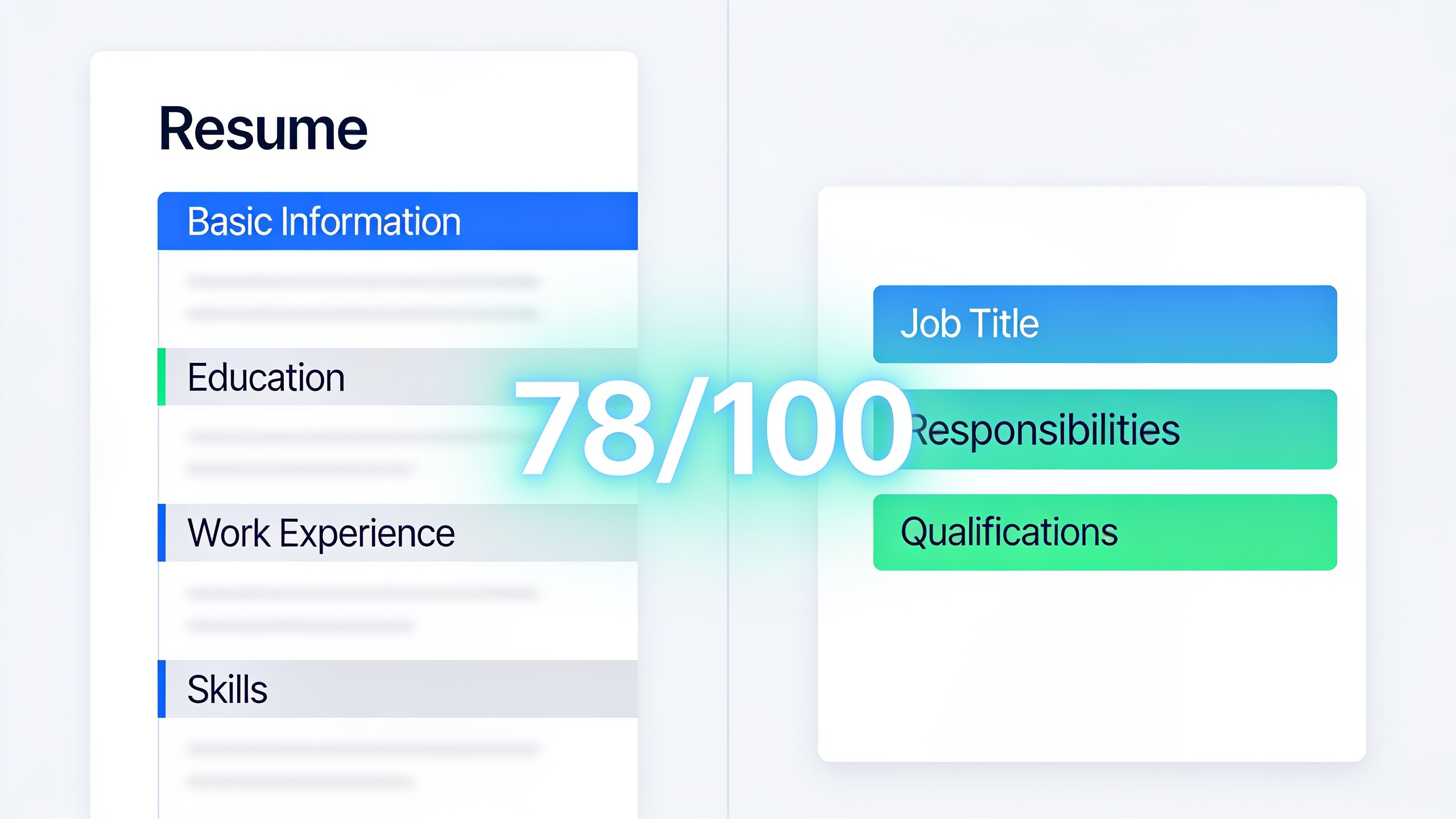
Why should you care? Because applying blindly wastes everybody's time, yours and the recruiter's. Once you get how a fitment score works and what it's actually measuring, you can quit guessing and start being strategic about where you put your energy. So in this piece I'll walk through what the score really means, how these AI matching engines come up with it, why it's worth checking before you apply, and how to nudge your number up for the jobs you genuinely want.
Table of Contents
- What Is a Resume Fitment Score?
- How Does AI Resume Matching Calculate a Fitment Score?
- Why Does Your Resume Fitment Score Matter Before You Apply?
- What Factors Influence a Resume Fitment Score?
- Resume Fitment Score vs. Traditional ATS Keyword Matching
- How to Improve Your Resume Fitment Score
- Common Mistakes That Lower a Fitment Score
- Frequently Asked Questions
What Is a Resume Fitment Score?
A resume fitment score is a number, usually a percentage or something out of 100, that tells you how well your résumé matches a specific job posting. Instead of leaving you to squint at a job description and wonder if you're "close enough," it hands you an actual data point to work with before you sink an hour into an application.
Think of it as a compatibility rating between two documents: your CV and the job description. And I want to be clear about something, because people get weird about this. The score is not a verdict on your worth as a professional. It's just a measure of how well the language and skills and experience on your résumé line up with the language and skills and experience the employer wrote in their posting. A high score usually means your résumé already speaks their language. A low one means there's a gap somewhere, maybe missing keywords, maybe a real experience shortfall, maybe just clumsy framing of what you actually did.
Platforms built around this, like JobScans.in, let you upload your CV and get a 0–100 fitment score for whatever posting you're eyeing. That single number becomes a quick gut-check. Is this job worth tailoring my résumé for, or is the gap so wide that no amount of editing is going to close it? If you're a fresh grad firing off applications to thirty entry-level roles, or someone trying to pivot into a whole new industry, that gut-check saves you hours you'd otherwise pour into applications that were never going anywhere.
How Does AI Resume Matching Calculate a Fitment Score?
AI resume matching calculates a fitment score by comparing the text and structure of your résumé against the text and structure of a job description, then scoring the overlap across several different dimensions instead of just counting keywords. That's the short version. "AI resume matching" is basically the umbrella term for the natural-language-processing stuff that lets software read a résumé and a job posting the way a recruiter would, just way faster and at way bigger scale.
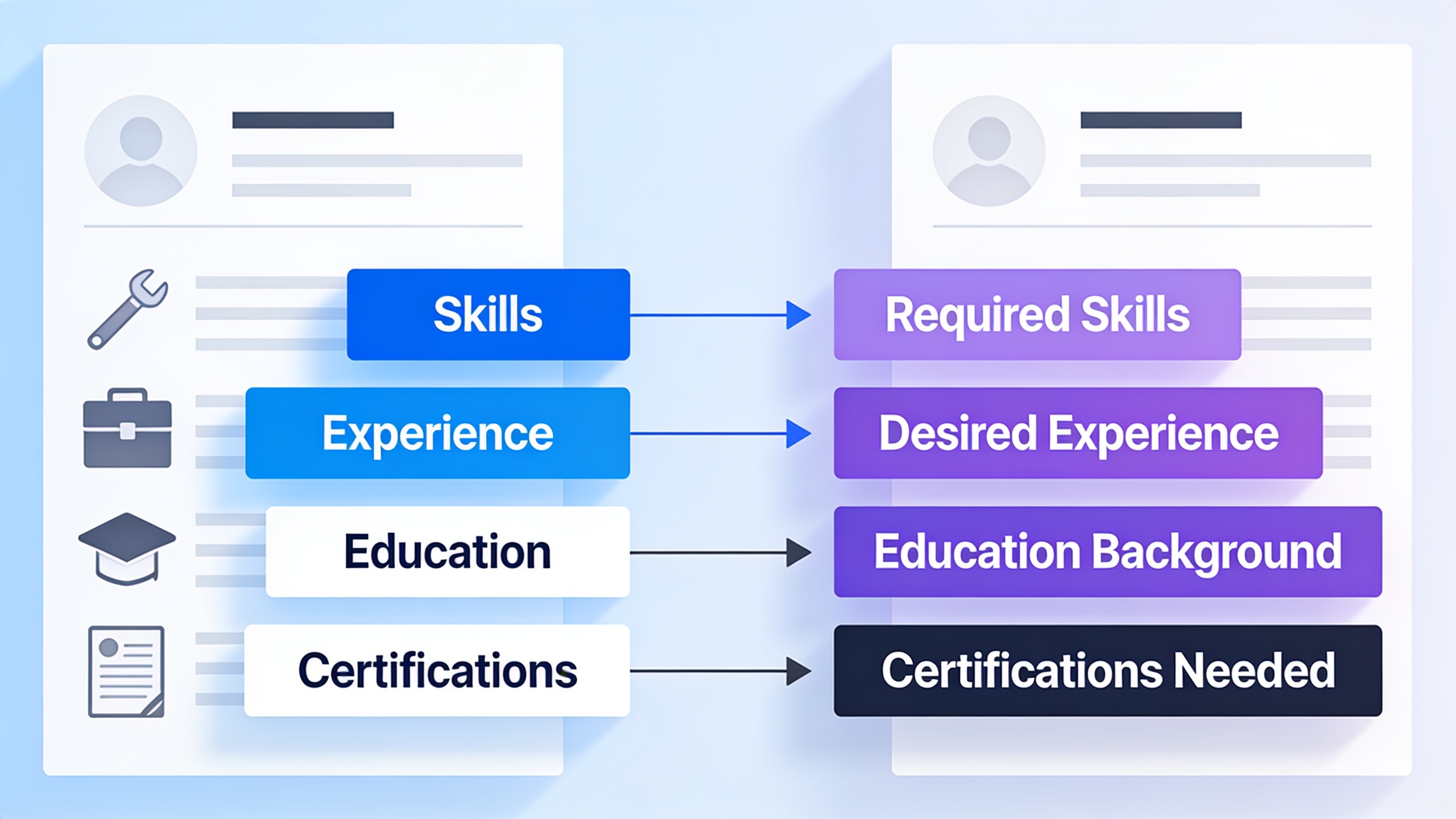
Here's roughly what's happening under the hood. Most of these systems take the job description apart into its pieces: required skills, preferred skills, years of experience, education level, certifications, the role-specific jargon. Then they do the exact same thing to your résumé, breaking your work history, skills, education, and achievements into comparable data points. Once both documents are chopped up like that, the software measures overlap and proximity. Not just "does the word Python show up," but "does this person's experience level, job titles, and described responsibilities actually look like what this employer is asking for?"
That's a real step up from the older applicant tracking systems (ATS), which is just software employers use to collect, sort, and filter applications, often by scanning for exact keyword matches. The problem with those older tools is they could be fooled, or worse, they'd unfairly ding a strong candidate over a formatting quirk, a synonym, or a missing exact phrase. The modern AI stuff tries to understand meaning and context, not just literal text. Which is why two résumés worded completely differently can land similar scores if the experience underneath is comparable.
In practice, tools like JobScans.in run this whole thing automatically. You upload your CV, the platform reads the posting you're targeting, and it spits back a fitment score plus the option to auto-tailor your résumé so the gaps it found actually get addressed. That auto-tailoring bit is where the tool stops being just a diagnostic and becomes an actual part of how you apply.
Why Does Your Resume Fitment Score Matter Before You Apply?
Your fitment score matters before you apply because it tells you, in advance, whether an application is even worth your time and how to tweak your materials to give yourself a real shot. Applying without checking fit is a little like walking into an exam without knowing the syllabus. You might do fine. But you're basically rolling dice.
For recent grads this is huge. Entry-level postings love to list a soup of "must-have" and "nice-to-have" qualifications, and it's genuinely hard to tell which requirements are flexible and which are hard walls. A fitment score gives you somewhere to start that isn't purely emotional ("I want this job so bad, I'll apply anyway") or purely defeatist ("I don't have three years, forget it"). There's a real difference between a 72/100 and a 38/100, and seeing that difference changes how much effort you sink into tailoring before you send anything.
Career switchers have a different problem, but it's just as real. Your résumé is probably stuffed with transferable skills that are described in the vocabulary of your old industry, not the new one. A fitment check can reveal you're way closer to qualifying than you thought. The gap is often phrasing, not substance. And that's exactly what auto-tailoring features, like the ones on JobScans.in, are built to fix, because they rewrite and reorganize your content to match the target job's language without inventing experience you don't have.
There's also just a raw volume thing. People apply to dozens of postings per search cycle now. Without some way to prioritize, you'll spend the same amount of time on a job you're a 90% match for as one you're a 20% match for. Checking the score first lets you pour your limited hours, the cover letters, the custom bullet points, the awkward "hey, do you know anyone at..." referral texts, into the applications where the effort might actually pay off.
What Factors Influence a Resume Fitment Score?
A fitment score comes down to a few layered things: keyword and skill overlap, how much relevant experience you have and at what level, whether your education and certifications match, and how cleanly your résumé's structure communicates all of that to the software reading it. No single one runs the show. It's the combination.
Skill and keyword alignment is usually the heavyweight. If a posting lists "SQL, Tableau, and stakeholder management" as requirements, the engine hunts for evidence of those specific things, and not just the literal words either. A line like "built quarterly dashboards for leadership review" hints at both Tableau and stakeholder skills even if you never named the tool. (Though honestly, if you actually used Tableau, just name it. Don't make the machine guess.)
Experience level and job titles matter too. A posting asking for a "Senior Analyst, 5+ years" is going to score someone with two years lower than someone with six, even if the skills overlap is basically identical. Then there's education and certifications, which really move the needle in fields where a degree or license is non-negotiable, think finance, healthcare, engineering.
And here's the one people forget: structure and clarity. A résumé that's a mess of graphics, dense paragraphs, or unlabeled sections is hard for anything to read accurately, human or AI. I've seen genuinely strong candidates score low purely because the parsing engine couldn't figure out where their experience was. Recency plays in too, obviously. A skill you last touched ten years ago carries less weight than one you used last month, especially in fast-moving stuff like tech and marketing.
Anyway, getting your head around these factors is useful even if you never run your résumé through a single scoring tool. It's just a solid framework for writing a better résumé, period.
Resume Fitment Score vs. Traditional ATS Keyword Matching
A fitment score and old-school ATS keyword matching are both trying to assess résumé-job fit, but they differ in how sophisticated they are, how transparent they are, and how much useful feedback you actually get out of them. Traditional ATS matching, the kind baked into a lot of employer systems, mostly checks whether specific words are literally present. AI-driven fitment scoring tries to model overall compatibility across several dimensions, and, crucially, it usually shows you the result instead of hiding it inside some recruiter's dashboard.
| Aspect | Traditional ATS Keyword Matching | AI-Driven Resume Fitment Score |
|---|---|---|
| Who sees the result | Recruiters/employers, not candidates | Candidates themselves, before applying |
| Matching method | Literal keyword/phrase detection | Contextual analysis of skills, experience, and role level |
| Handles synonyms/related terms | Often poorly | Generally better, though not perfect |
| Actionability for job seekers | Low — candidate gets no direct feedback | High — score can guide résumé edits |
| Common output | Pass/fail filter or internal ranking | Numeric score (e.g., 0–100) with details |
| Example platform | Employer-side ATS software | JobScans.in (candidate-facing fitment score) |
The big practical difference for you is visibility. Traditional ATS matching happens in the dark. You apply, the system quietly decides whether you advance, and you rarely find out why you got filtered out. A candidate-facing fitment score flips that. You see the number, often with the reasoning behind it, before you commit. That's what turns the whole thing from a gatekeeper into an actually useful self-assessment tool.
How to Improve Your Resume Fitment Score
You raise your fitment score by editing your résumé to reflect the language, skills, and experience level in the job description more accurately, and I cannot stress this enough, without lying about qualifications you don't have. The point isn't to game the algorithm. It's to make sure your real qualifications show up in terms the algorithm (and the human reading it afterward) can actually recognize.
Start by reading the job description properly. Note the specific skills, tools, and qualifications, especially anything that shows up more than once or sits under "required" instead of "preferred." Then check whether your résumé already reflects that stuff in similar language. If you did the work but described it in different words, rewrite those bullet points to mirror the posting's terminology. As long as it's still an honest account of what you did, this is fair game.
Then look at your structure. Clear section headers (Experience, Education, Skills, Certifications), consistent date formatting, plain bullet points. That kind of thing parses way more reliably than dense paragraphs or those gorgeous design-heavy templates with text boxes and columns. Simpler genuinely wins here, and not just for looks.
If you can't tell how your résumé reads from the outside (and honestly, none of us can read our own writing clearly), build yourself a little feedback loop. Some people just ask a former colleague or mentor to eyeball a draft against a target posting. Others get more structured about it. Using something like Curio Surveys to throw together a short custom questionnaire for the peers or mentors reviewing your drafts can surface blind spots you'd never catch just rereading the thing yourself. Pair that with an automated fitment score and you've got two totally different lenses on the same question: does this résumé actually say what I think it says?
Finally, lean on the auto-tailoring features on platforms like JobScans.in instead of firing the same generic résumé at everyone. Auto-tailoring takes the gaps your fitment score flagged and suggests or applies edits that pull your résumé's language and emphasis closer to the target job, and from there you can also generate a matching cover letter for that same role.
Worth pointing out: this underlying idea, using automation to match your content precisely to what an audience or algorithm wants, isn't unique to résumés at all. In content marketing, for instance, platforms like RobinRank run on the same logic, using AI to automate SEO content writing and publishing so the content lines up with what search engines and readers are actually after. Resume fitment scoring is basically the same trick pointed at your career documents. Use AI to align what you've made with what the reader, in this case an employer, wants to see.
Common Mistakes That Lower a Fitment Score
A handful of really avoidable mistakes drag fitment scores down, and almost all of them come from treating your résumé as one fixed document instead of something you adapt per application. Spotting these is usually the fastest way to bump your score without earning a single new credential.
The biggest one is using a single résumé for everything. A résumé built for a "Marketing Coordinator" role will rarely score well against a "Marketing Analyst" posting, even though the titles sound like cousins, because the required skills and vocabulary just aren't the same. Sending one unedited résumé to different types of roles is probably the number one reason people see low scores.
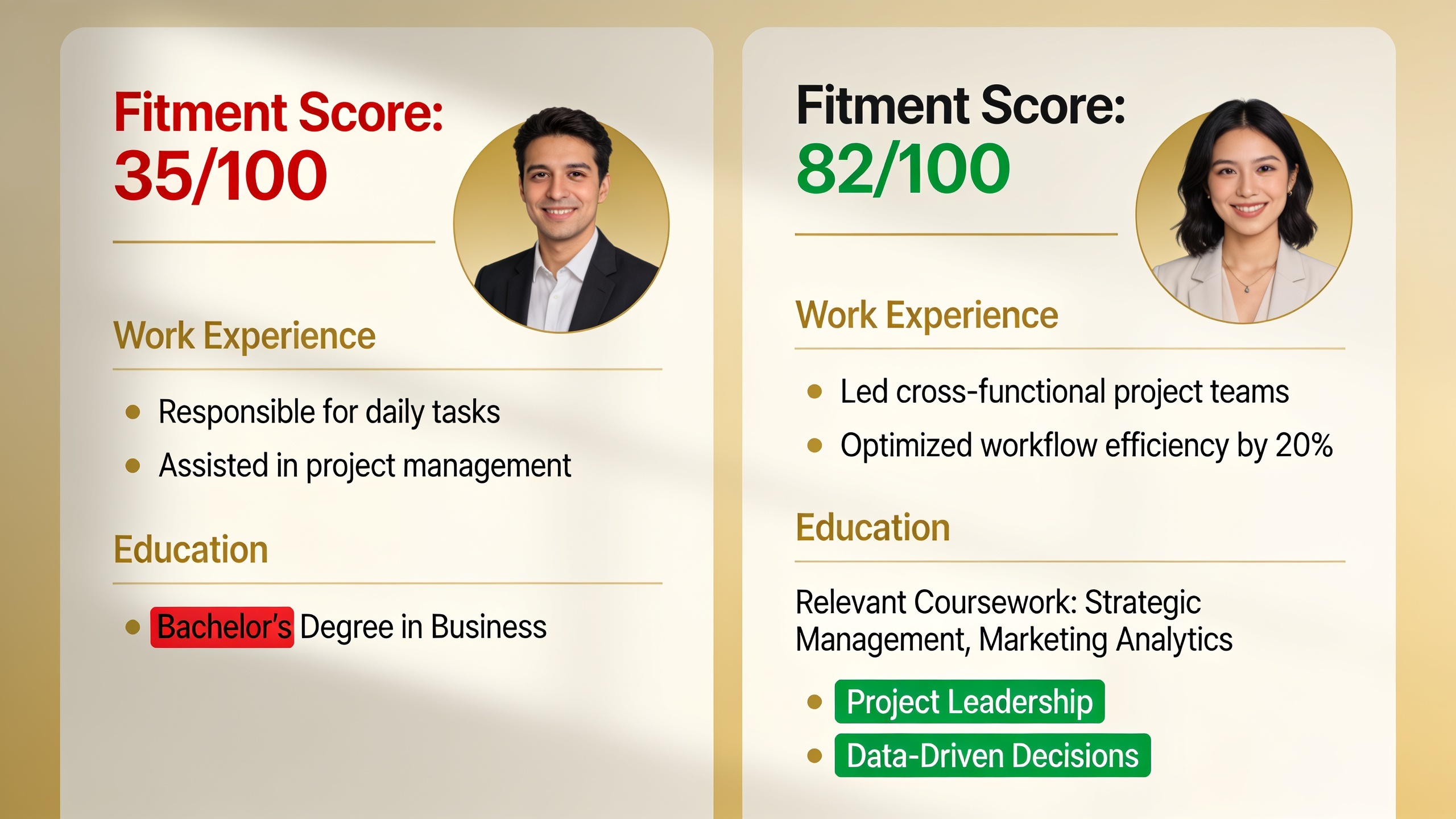
Then there's vagueness about tools. "Used various software tools" scores worse than "Excel, Salesforce, HubSpot" (assuming you actually used them) because these engines are specifically hunting for named skills that map to the posting. Related mistake: burying your best stuff. If your most relevant experience is from three jobs ago, or hiding in the third bullet of a long list, it gets underweighted next to more prominent but less relevant content. Reorder it. Put the good stuff up front.
Two more that trip people up:
- Overly creative formatting. Text boxes, graphics-heavy templates, weird section orders. They look great to a human and completely confuse the parser, so your skills just... vanish. Not because they aren't there, but because the machine couldn't read them.
- Ignoring seniority signals. Applying to a "Senior" role with a résumé that reads clearly junior (or the reverse) creates a mismatch the score will absolutely catch. Reframing how you talk about scope, ownership, and impact can close that gap, as long as your actual experience backs it up.
Frequently Asked Questions
Is a resume fitment score the same thing as an ATS score?
Not really. A traditional ATS score usually gets calculated by employer-side software and stays hidden from you, leaning heavily on literal keyword matches. A fitment score, like the ones from candidate-facing platforms such as JobScans.in, is shown straight to you and comes from AI matching that weighs skills, experience level, and context, not just whether a keyword happens to appear.
What actually counts as a "good" fitment score?
There's no universal magic number, honestly, because different platforms score differently. As a rule of thumb, higher means your résumé lines up closely with that specific posting, and lower means there are bigger gaps in skills, experience, or wording you'd probably want to sort out before applying.
Can I improve my score without lying on my résumé?
Yes, and please stick to the honest improvements. Most of the gains come from describing real experience in the language the posting uses, reordering things to spotlight relevant work, and fixing formatting or structure problems. None of it comes from inventing skills you don't have.
Does a low score mean I just shouldn't apply?
Not necessarily. A low score is information, not a rejection letter. Sometimes it means the role's a genuine stretch. Sometimes it just means your résumé needs tailoring to reflect experience you already have. Treat it as a diagnostic that tells you where to focus your editing, not a bouncer at the door.
How does AI resume matching deal with career changers and transferable skills?
The engines that analyze context instead of just literal keywords are generally better at spotting transferable skills, since they can recognize related competencies even when you've described them in old-industry language. That said, career changers still tend to benefit from actively rewriting things in the target industry's terminology, because even the smart contextual engines need some relevant vocabulary to work with.
---
Look, a fitment score won't hand you an interview, and it's no substitute for real qualifications or a cover letter that doesn't put people to sleep. What it does give you is clarity: a concrete, data-informed way to see how your CV stacks up against a specific job before you burn time applying, plus a solid starting point for actual improvements. And for anyone slogging through a crowded market, whether you're a fresh grad sending out your first batch or someone trying to pivot into something new, that kind of clarity is genuinely worth building into your routine.