
That's the frustrating part. Most people who get ghosted aren't unqualified. They just got quietly filtered out before a single human being read a word of their story. Recruiters and the software they lean on are hunting for very specific signals, and when those signals are missing or garbled, your resume sinks to the bottom of the pile or gets rejected outright.
So let's go through the ten most common reasons that happens, why each one hurts, and how to actually check whether your resume stands a chance before you hit "apply" for the hundredth time. Whether you're fresh out of school firing off your first batch of applications, switching industries, or just baffled about why the interviews aren't coming, these patterns can save you months of grinding your teeth.
Table of Contents
- What Happens to Your Resume Before a Human Recruiter Ever Sees It?
- 10 Resume Mistakes That Trigger Instant Rejection
- How Recruiters Scan a Resume in Seconds
- Resume Mistakes vs. Quick Fixes at a Glance
- Avoiding These Resume Mistakes With a Fitment Score Check
- Explaining Career Gaps and Nontraditional Paths Without Raising Red Flags
- Frequently Asked Questions
- Final Thoughts
What Happens to Your Resume Before a Human Recruiter Ever Sees It?
Before a recruiter ever lays eyes on your resume, it almost always gets chewed through by an Applicant Tracking System (ATS) first. That's software that scans, parses, and ranks resumes based on keyword matches, formatting, and how well you line up with the job description. If your resume doesn't parse cleanly or match enough of what the role asks for, it can get buried or dumped long before a human weighs in.
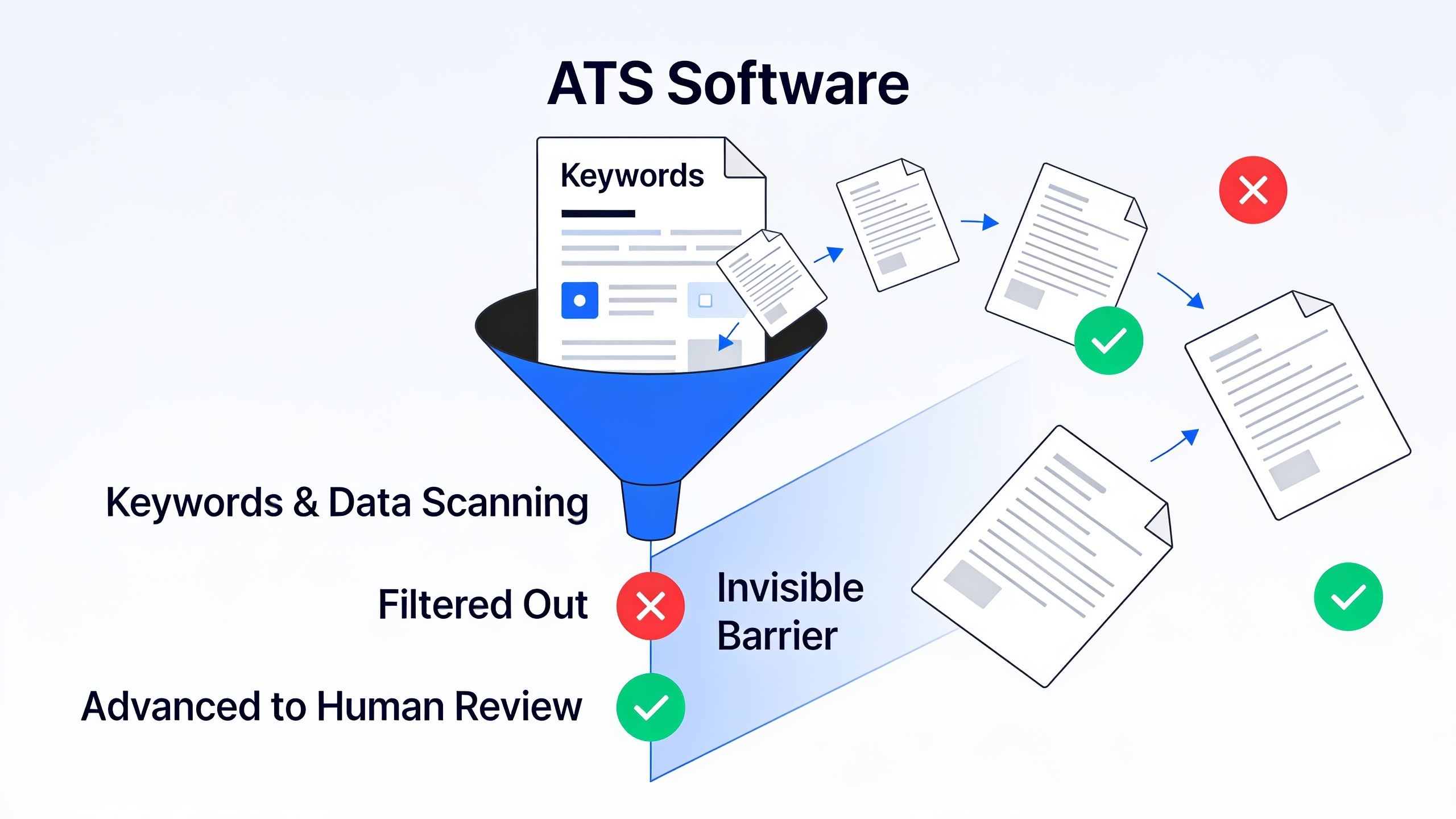
This is honestly one of the most misunderstood parts of hiring right now. A lot of people picture a hiring manager sitting down and reading every application over coffee. In reality, big companies (and plenty of mid-sized ones) push everything through software first. The ATS pulls your work history, skills, education, and contact info into a structured profile, then holds that up against the keywords and qualifications the employer typed in for the role. If the software chokes on your resume because of a fancy layout, a weird file format, or missing section headers, your qualifications might not register at all. Even if you're genuinely perfect for the job.
That's exactly why so many strong candidates get rejected and never hear a peep. If you want the full mechanics of how this filtering works and why it trips up so many people, it's worth reading Why 75% of Resumes Get Rejected by ATS Systems, which digs into the details. Getting your head around this layer is really step one. Everything else builds on it.
10 Resume Mistakes That Trigger Instant Rejection
These ten mistakes cause the overwhelming majority of silent rejections. And by silent, I mean you never get a call, an email, or even the courtesy of a generic "thanks but no thanks." Here's each one, why it burns you, and what to do instead.
1. Your Resume Is a Generic, One-Size-Fits-All Document
Blasting the exact same resume at every posting is one of the fastest ways to get filtered out. Both recruiters and ATS software are looking for alignment between your resume's language and the specific job description in front of them. A generic resume almost never has the exact keywords, tools, and phrasing from the posting, and that tanks your match score.
Now, I'm not saying rewrite the whole thing from scratch every single time. Nobody has time for that. But tweak the summary, the skills section, and the phrasing in your bullet points so they echo the language of each role you're chasing.
2. It's Loaded With Buzzwords Instead of Real Achievements
"Results-driven team player." "Highly motivated self-starter." These tell a recruiter absolutely nothing. When a resume leans on vague adjectives instead of actual accomplishments, it reads like filler, and experienced recruiters skim right past it. I've done it myself, my eyes just glaze over.
Swap the buzzwords for numbers and outcomes wherever you can. "Increased regional sales by 22% over two quarters" says infinitely more than "driven sales professional." One is evidence. The other is a bumper sticker.
3. The Formatting Confuses the ATS
Resumes built with tables, text boxes, columns, headers and footers, or graphics tend to get mangled the second an ATS tries to turn them into plain text. If the system can't figure out your job titles, dates, or skills section, it might misfile your experience or just drop chunks of it entirely. This one's especially brutal because it's completely invisible to you.
Stick with a single-column layout and standard headings like "Work Experience," "Education," and "Skills." Save it as a .docx or a text-based PDF, and whatever you do, don't bury important info inside images or design flourishes.
4. Your Skills Section Doesn't Match the Job Description's Keywords
If a posting keeps hammering on "stakeholder management," "SQL," or "Agile methodology" and none of those exact terms appear anywhere on your resume, both the software and the recruiter may decide you don't have the experience. Even if you've literally done the same work, just under different terminology.
Read the description closely and mirror its specific keywords in your skills and experience sections, as long as they honestly reflect what you've actually done. This one change punches way above its weight. It's often the difference between advancing and disappearing.
5. There Are Typos, Inconsistent Formatting, or Grammar Errors
Small errors do disproportionate damage. A recruiter plowing through hundreds of applications will happily use one typo as an excuse to move on, especially for roles where attention to detail matters. Which is, let's be real, most roles. Inconsistent date formats, mismatched fonts, wobbly bullet points, they all whisper the same thing: careless.
Proofread it out loud. Run a spell-checker. And if you can, get a second pair of eyes on it before it goes anywhere. You've stared at the thing so long you've stopped seeing it.
6. Your Resume Doesn't Explain Career Gaps or Job Hops
Unexplained gaps or a string of very short stints with no context raise questions that a lot of recruiters won't bother asking you about. They'll just move to the next application. This is one of the biggest silent killers for career changers and folks coming back after time away.
A short, honest line fixes it. Something like "career break for caregiving" or "freelance consulting during transition" clears the ambiguity instantly and keeps the spotlight on your qualifications instead of the empty stretch on the timeline.
7. It's Either Too Long or Too Thin on Relevant Detail
A ten-page resume for a mid-level job screams "I can't prioritize." A resume with two lonely bullet points per role screams "I never made an impact." Both extremes get noticed, and neither in a good way.
For most people outside academia or heavy research fields, one to two pages is the sweet spot. Give your most relevant and recent experience the most room, and be ruthless about the rest.
8. The Contact Information or File Naming Is Unprofessional
An outdated email, a missing LinkedIn URL, a file named "resume_final_v3_ACTUALFINAL.pdf." Individually these seem trivial. Together they paint a picture of someone slightly disorganized before the recruiter has read a single bullet.
Use a grown-up email address. Name the file something clean like "FirstName_LastName_Resume.pdf." And double-check that your phone number and location are actually current, not the ones from two apartments ago.
9. Your Job Titles and Responsibilities Don't Match the Role You're Applying For
If you're pivoting or reaching for something a step beyond your last title, a resume that doesn't explicitly translate your old responsibilities into the new context reads like a mismatch. Even when the underlying skills transfer perfectly. This trips up industry switchers constantly, because the same skill set gets described in totally different vocabulary from one field to the next.
Reframe your past work in the language of the target role, and think about adding a short summary up top that connects the dots for the reader. Don't make them do the mental translation. They won't.
10. You're Not Tracking How Well Your Resume Actually Matches Each Job
The most overlooked mistake of all might be applying without ever objectively checking how closely your resume lines up with a given posting. Most people go on gut feeling and a quick reread, which makes it stupidly easy to miss keyword gaps, formatting problems, or missing qualifications that a systematic check would flag in seconds.
This is where tools that spit out a fitment score, basically a number estimating how well your resume matches a job description, can surface blind spots you'd never catch on your own. More on that in a bit.
How Recruiters Scan a Resume in Seconds
Recruiters spend only a handful of seconds on that first pass, which means your most important qualifications have to jump out immediately, not hide on page two. An eye-tracking study by the recruiting firm TheLadders found that recruiters spend an average of just seconds skimming a resume before deciding whether to keep reading or bail, and their attention is glued to the top third of the first page: your name, most recent title, company, and dates.
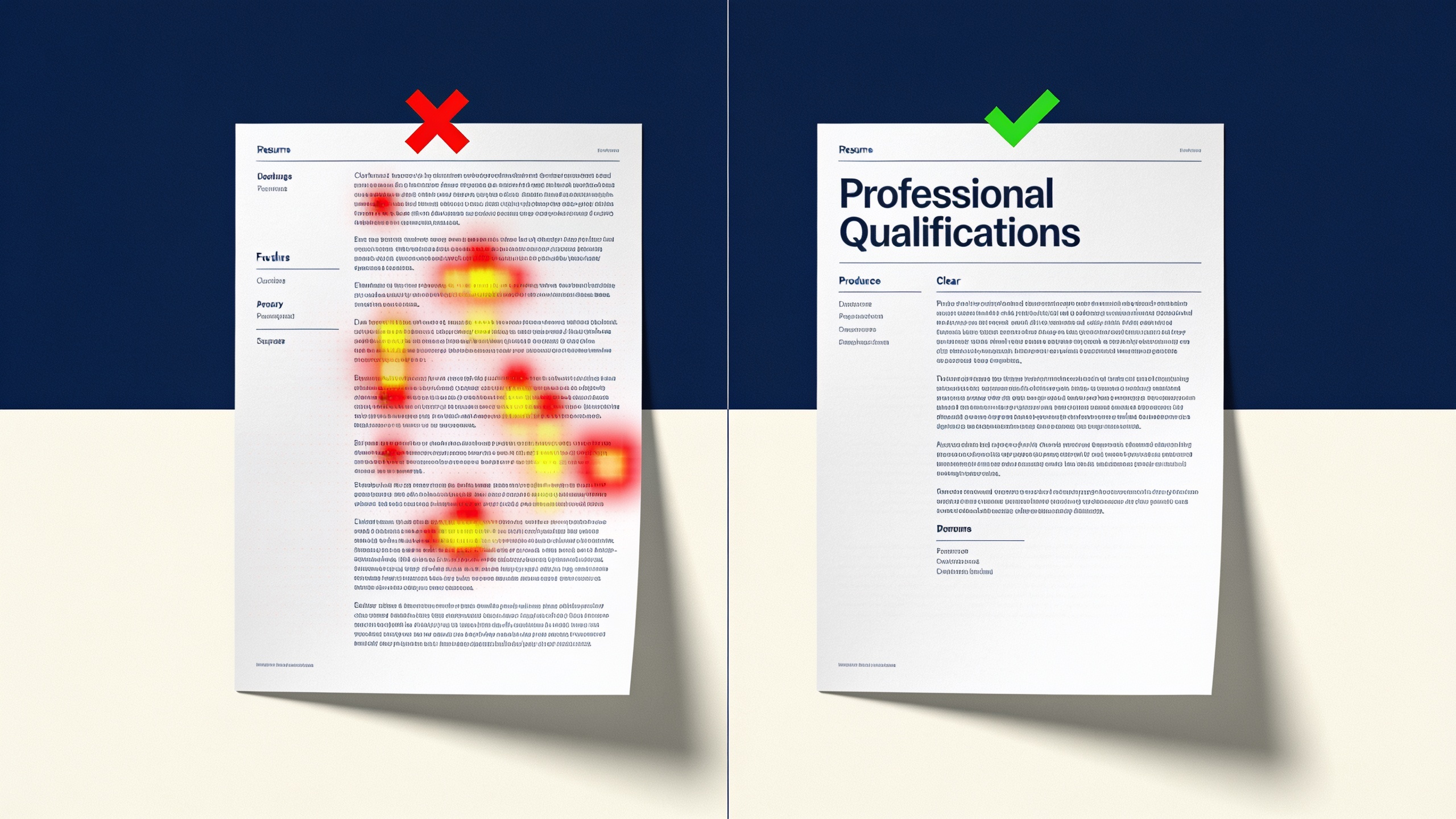
That should completely change how you think about layout. The top of page one is prime real estate, and it needs to answer one question fast: "Is this person right for this specific role?" If a recruiter has to go digging for your job title, your key skill, or your years of experience, you've already lost them. It's also why a cluttered header, a musty objective statement instead of a targeted summary, or an awkwardly placed job title can quietly sink an otherwise great resume. They squander the few seconds you actually get.
And there's another gut-punch stat. A widely cited CareerBuilder survey found that a majority of resumes reviewed by hiring managers contained at least one typo. So most of your competition is fumbling on the basics, which is great news if you're careful, and a warning if you're not. Put the short scan time together with that typo stat and it's obvious why the ten signs above carry so much weight. There's barely any room for a resume to recover from a rough first impression.
Resume Mistakes vs. Quick Fixes at a Glance
Here's everything from above boiled down, with a fast fix for each that you can apply before your next application.
| Resume Mistake | Why It Hurts You | Quick Fix |
|---|---|---|
| Generic, non-tailored resume | Low keyword match with job description | Adjust summary and skills per posting |
| Buzzwords without evidence | Reads as vague, unconvincing | Replace with quantified achievements |
| Complex formatting (tables, columns) | ATS misreads or drops information | Use simple, single-column layout |
| Missing job-specific keywords | Ranked low by ATS and recruiter | Mirror exact terms from job listing |
| Typos and grammar errors | Signals carelessness | Proofread aloud and get a second reviewer |
| Unexplained employment gaps | Raises unanswered questions | Add a brief, honest one-line explanation |
| Too long or too thin | Suggests poor prioritization | Aim for one to two focused pages |
| Unprofessional contact details/file name | Creates a disorganized first impression | Use clean email and file naming |
| Titles don't map to target role | Looks like a mismatch on paper | Reframe experience in target-role language |
| No fitment check before applying | Blind spots go unnoticed | Run a fitment score check before submitting |
Avoiding These Resume Mistakes With a Fitment Score Check
The quickest way to catch most of these mistakes before they cost you an interview is to actually measure how well your resume matches a posting instead of guessing. A fitment score is a number, usually on a 0 to 100 scale, that estimates how closely your resume's content lines up with a job description's requirements, keywords, and expectations.
JobScans is an AI-driven job-search platform built for exactly this. On jobscans.in, you upload your CV and get a 0–100 fitment score against a specific listing, which gives you a concrete read on how competitive you're likely to be before you even submit. Beyond the score, it can auto-tailor your résumé to a job description and generate a matching cover letter, which knocks out several of the problems above at once, especially the generic-resume trap, missing keywords, and mismatched titles. According to the platform, it's free to start, so it's a pretty low-risk first move if you've been applying broadly and getting nowhere.
And to be clear, running a fitment check isn't about gaming the system. It's about closing the gap between what you've actually done and how clearly that lands on paper. Honestly, most job seekers are better candidates than their resumes make them look. The score just points to where the disconnect is so you can patch it before you apply, not after you've already been rejected.
Explaining Career Gaps and Nontraditional Paths Without Raising Red Flags
Career gaps and nonlinear histories aren't automatically disqualifying, but they do need a short, clear explanation so recruiters aren't left filling in the blanks themselves. A gap turns into a red flag mainly when it's unexplained, not simply because it exists. That distinction matters a lot.
And this is more relevant now than it used to be, because work patterns keep diversifying. People take deliberate breaks for travel, caregiving, further study, or freelance projects. Some are even getting clever about funding extended time off. A few travelers, for instance, use home-exchange platforms like Swappahome to swap properties instead of shelling out for accommodations, which can make a sabbatical or a long break actually affordable. If you did something like that, a confident one-liner such as "Career break for extended travel and independent projects, 2023" reads a whole lot better than silence. Silence just invites assumptions, and they're rarely generous.
Same logic goes for nontraditional paths in general. Freelance work, contract gigs, self-directed study, industry switches, all of them benefit from a brief narrative thread that ties things together. Recruiters usually aren't penalizing the gap or the pivot itself. They're penalizing the missing context, which is genuinely one of the easiest fixes on this whole list.
Frequently Asked Questions
How many mistakes does it actually take to get rejected?
There's no magic number. A single serious problem, like an ATS-breaking format or a keyword profile that's completely off, can be enough on its own. But a bunch of little ones (a typo here, a vague bullet there) can pile up to the same result. These signs tend to compound each other, so even fixing two or three can noticeably lift your response rate.
Can a genuinely good resume still get rejected by an ATS?
Yep. Even a strong, well-written resume can get filtered out if the formatting stops the ATS from reading it properly, or if the keyword match is just too low. That's why understanding how ATS filtering works, which Why 75% of Resumes Get Rejected by ATS Systems breaks down, matters as much as the writing itself.
Should I really use the same resume for every application?
Please don't. Tailoring your summary, skills section, and key bullets to each specific description meaningfully boosts your keyword match and relevance, and that directly affects whether you clear the first screen. The extra ten minutes is worth it.
What counts as a "good" fitment score?
Depends on the platform and the job, since everyone scores things differently, but broadly, a higher number means tighter alignment between your resume and the role's stated requirements. Honestly though, the value isn't the number itself. It's spotting which specific gaps (missing keywords, fuzzy titles, thin experience) are dragging you down so you can fix them.
How long should a resume be if I don't have much experience yet, like a new grad?
One page is usually plenty for early-career folks. The focus should be quality and relevance, not length. Padding a thin resume with filler or fussy formatting tends to backfire, whereas a tight, well-tailored one-pager that clearly matches the job almost always performs better.
Final Thoughts
Most silent rejections come down to a small stack of fixable mistakes. Mismatched keywords, confusing formatting, unexplained gaps, no concrete achievements. Rarely is it an actual shortage of talent. Work through the ten signs above, check your resume against real job descriptions instead of trusting your gut, and close the gaps one at a time. Do that and the responses tend to start trickling back.
So if you've been firing applications into what feels like a void, it's probably not about your experience at all. It's about how clearly that experience is coming across on the page. And that? That you can fix.