
Doesn't matter whether you're an engineer, a commerce grad, or you spent three years reading literature and now can't fully explain to your relatives what you're job-hunting for. The path to that first offer letter is more predictable than people think. You need a resume that survives the automated gatekeepers, interview answers that show you can actually think, and a working knowledge of a few AI tools your competition probably hasn't figured out yet. That's basically it. This guide walks through all of it so you're moving with a plan instead of just... vibes.
Table of Contents
- Understanding the Indian Fresh Graduate Job Market
- How Do I Write a Resume for My First Job in India?
- Building a Graduate Job Search Guide Strategy
- Interview Preparation That Actually Works
- How Can AI Tools Help You Get Your First Job in India?
- Common Mistakes Fresh Graduates Make
- Managing the Emotional Side of Job Hunting
- FAQ: First Job in India for Fresh Graduates
Understanding the Indian Fresh Graduate Job Market
Getting your first job in India means competing in one of the most crowded entry-level hiring markets on the planet, where a single LinkedIn or Naukri posting can pull in hundreds of applications inside 48 hours. So before you send off another application, it helps to understand what actually filters people out. Because it's usually not who you'd think.
Most mid-size and large companies here (IT services firms, FMCG giants, well-funded startups, all of them) run inbound applications through an Applicant Tracking System, or ATS. It's software that scans, ranks, and often straight-up auto-rejects resumes based on keyword matches, formatting, and how well they line up with the job description. All of this happens before a human recruiter ever opens your file. Which means your resume isn't competing against other people first. It's competing against an algorithm that doesn't care how nice you are.
If you've ever watched a genuinely strong candidate never hear back, this is usually why. Some formatting quirk or missing keyword quietly killed the resume before it reached anyone who could appreciate it. There's a proper breakdown of exactly how this works in Why 75% of Resumes Get Rejected by ATS Systems, and honestly, I'd read that before you fire off your next batch of applications.
Fresh graduates typically find work through a handful of channels: campus placements, job portals like Naukri, LinkedIn, Indeed and Foundit, company career pages, referrals, and increasingly, cold-ish outreach on LinkedIn. And here's the part people miss. Each channel rewards a different game. Campus placements care about your grades and how you hold up in a group discussion. Portal applications live and die on whether your keywords match. So the channel you're using should actually change how you prep, not just where you click submit.
How Do I Write a Resume for My First Job in India?
Your resume for a first job in India should be one page, ATS-readable, and built around measurable achievements instead of a list of duties you sort of did. That last part is the single biggest shift most fresh graduates need to make. Recruiters here usually spend under 10 seconds on a first scan, so clarity beats creativity every time.
Structure That Recruiters and ATS Both Understand
Keep it boring and linear: contact details, a two-line summary, education, skills, projects and internships, then certifications. I know the fancy templates with the columns and little skill-bar graphics look great. The problem is ATS parsers routinely choke on them, misreading your info or skipping entire sections. A clean single-column Word or PDF in a standard font (Calibri, Arial, whatever's normal) at 10 to 12pt is still the safest bet for most Indian employers in 2024. Not exciting. But it works.
Turn Coursework and Internships Into Achievements
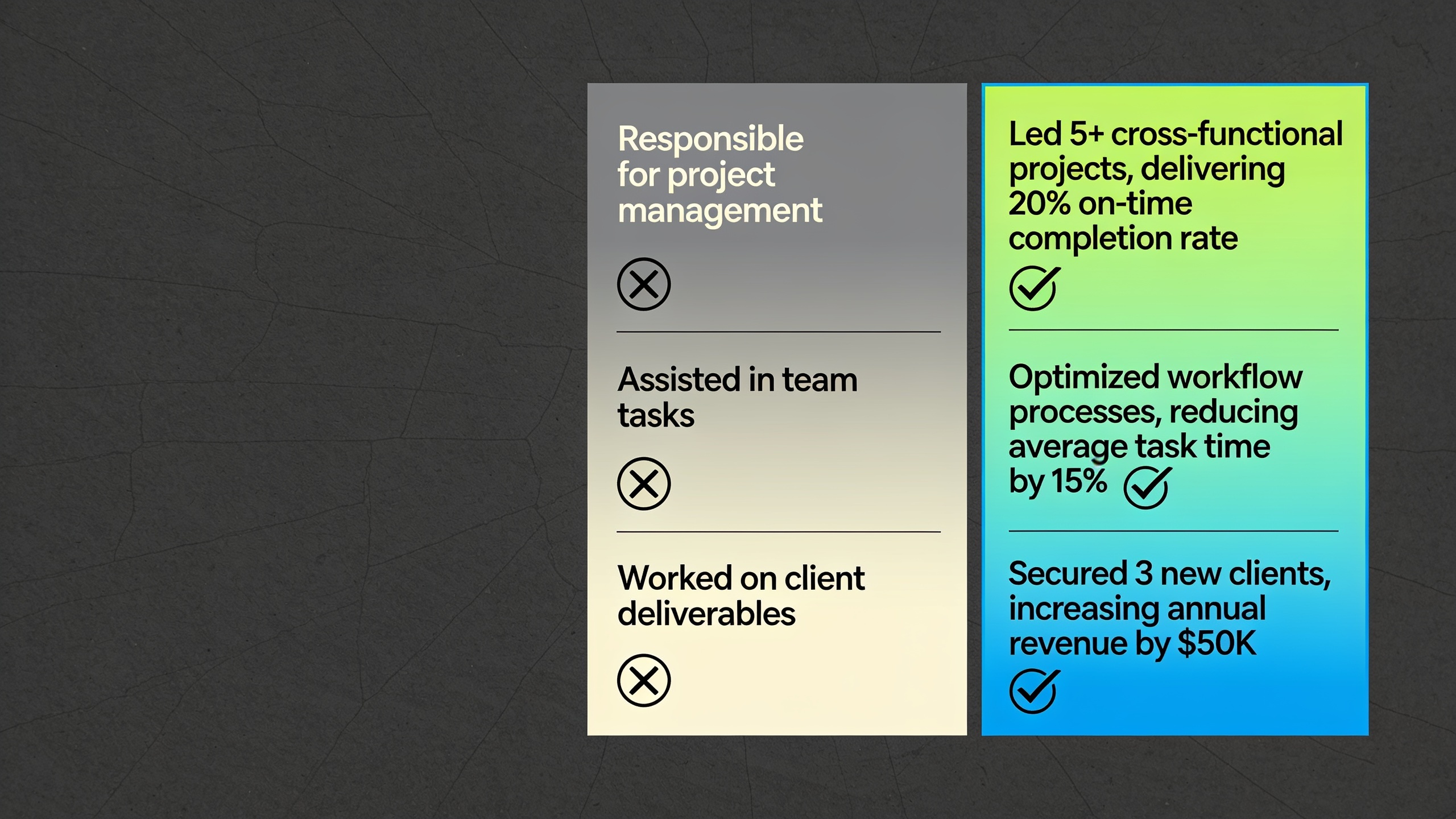
Here's where most freshers leave points on the table. They write responsibilities ("Assisted in marketing tasks") when they should be writing outcomes ("Ran a college fest social media page that grew followers from 200 to 3,000 in eight weeks"). See the difference? One tells me nothing. The other tells me you can actually move a number.
Every internship, capstone project, or club role can be reframed with a result, a metric, or a specific tool you used. And if you don't have paid work experience? Treat your academic projects, hackathons, and volunteer work as legitimate professional experience. Because when a hiring manager is looking at freshers, that's exactly what those things are.
Match the Keywords in the Job Description
Since the ATS ranks resumes by how much they overlap with the job posting, you want to mirror the posting's language wherever it's honestly true of you. If the listing says "data analysis using Excel and SQL," your resume should say Excel and SQL, not something fuzzy like "handled data." This is also why tailoring every single resume by hand takes forever, and it's exactly the problem AI tailoring tools were built to solve. More on those in a bit.
| Resume Element | Weak Version | Stronger Version |
|---|---|---|
| Format | Multi-column template with icons | Single-column, ATS-friendly layout |
| Experience line | "Worked on college project on sales" | "Analyzed 3 months of retail sales data in Excel to identify top 5 underperforming SKUs" |
| Skills section | "Good communication, hardworking" | "Client presentations, MS Excel, SQL basics, stakeholder communication" |
| Length | 2–3 pages covering every activity since school | 1 page focused on the last 2–3 years |
| Keyword alignment | Generic terms unrelated to the job post | Terms mirrored directly from the job description |
Building a Graduate Job Search Guide Strategy
A graduate job search strategy just means treating your hunt like an actual project, with weekly targets, tracked applications, and a mix of channels, instead of applying at random whenever guilt strikes. Freshers who work this way get more callbacks for a boring reason: they're consistent and targeted while everyone else is scattered.
Start by picking three to five target roles. Not thirty. A commerce grad might go after "business analyst trainee," "finance associate," and "operations executive" rather than clicking apply on every listing that contains the word "graduate." Narrowing down lets you tailor your resume and prep relevant answers instead of spraying the same generic application everywhere, which, trust me, recruiters clock in about two seconds.
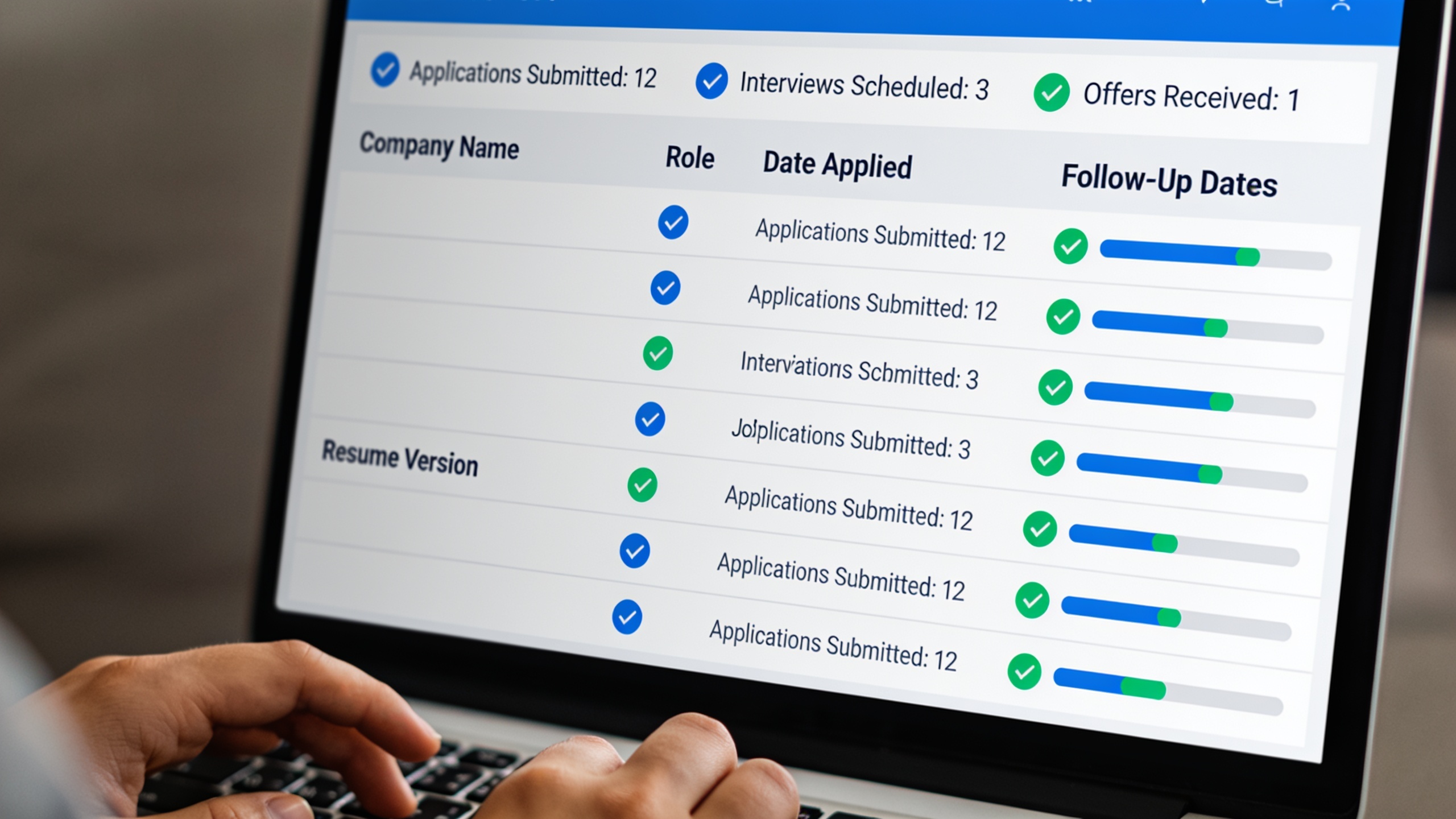
Then build a tracker. A basic spreadsheet is completely fine. Log the company, role, date applied, which resume version you sent, and when to follow up. Sounds like overkill until you're six weeks deep and genuinely can't remember what you sent where. A search that drags on for two or three months (very normal for freshers in India) needs this scaffolding to keep you sane.
And spread your effort deliberately across channels. Split your week between portal applications, direct career-page applications, a few LinkedIn messages to alumni, and whatever your placement cell still offers if you've got access. Oh, and if you're juggling a long-delayed family trip on top of all this stress, don't let the logistics pile on. Services like Global Holiday Planner exist specifically to sort out flights, hotels, and transfers so your brain stays on interviews instead of itineraries.
Interview Preparation That Actually Works
Good interview prep for a first job in India means practicing structured, specific answers to a fairly predictable set of question types, not memorizing scripts you'll robotically recite and forget under pressure. Most entry-level interviews here have three parts: an HR screening call, a technical or role-specific round, and a final round with a hiring manager or panel. Each one rewards different prep.
The HR Screening Round
This is your background, your read on the role, salary expectations, and the classic fit questions. "Why should we hire you?" "Where do you see yourself in three years?" Freshers trip here not because the questions are hard, but because they've never said the answers out loud. Practice with a timer, aiming for 60 to 90 seconds per response. Rambling is one of the most common reasons HR teams give for rejecting fresh-grad candidates, and a timer fixes it faster than anything else.
The Technical or Role-Specific Round
For technical roles, dust off the core concepts from your degree. DSA and CS fundamentals for software, accounting standards for finance, basic stats for analytics. For non-technical roles, expect case-style or scenario questions like "How would you handle an unhappy client?" Whatever the field, structure your answer: say what you understand the problem to be, walk through your approach, land on a conclusion. For entry-level candidates, that structure honestly matters as much as the content itself.
The STAR Method for Behavioral Questions
STAR is Situation, Task, Action, Result. It's a simple frame for behavioral questions like "Tell me about a time you handled conflict" or "Describe a challenge you overcame." You can pull STAR answers from group projects, internships, part-time work, even sports or student council. The interviewer cares way more about how you think and act under pressure than about how big or impressive the situation was.
Do a few mock interviews before the real one. With a friend, a counselor, honestly even a mirror. It works because it drags all your filler words and weak transitions and non-answers out into the open where you can fix them. It costs basically nothing, most freshers skip it, and it shows.
How Can AI Tools Help You Get Your First Job in India?
AI tools can help you land your first job in India by scoring how well your resume matches a specific posting, auto-tailoring your resume's language to that posting, and spitting out a first-draft cover letter. Basically, work that used to eat hours per application now takes minutes. For a fresher applying to dozens of roles in a tight window, that's not a small thing. Customizing every resume by hand simply doesn't scale.
Take JobScans, an AI-driven job-search platform built for the Indian market. You upload your CV and get a 0 to 100 fitment score against a specific job posting, so you can literally see how closely your background lines up with what the employer wants before you hit apply. I like this approach for freshers especially, because it kills the guessing. Instead of wondering "am I even a fit?", you get a number, plus the specific gaps dragging it down. Missing keywords, unclear phrasing, skills you never mentioned.
Beyond scoring, JobScans also does resume auto-tailoring and cover letter generation, which knocks out the two most tedious parts of applying at volume: rewriting your resume for every posting and drafting a fresh cover letter each time. Per JobScans' own platform description, it's free to start, which makes it a pretty low-risk way to test whether AI tailoring actually bumps your callback rate versus firing the same static resume at everyone.
But let's be clear-eyed here. An AI fitment score or a tailored resume can help you clear initial screening and present your real experience more cleanly. What it can't do is invent skills you don't have, and it definitely won't sit in for you during interview prep once you get the call. Used right, these tools are a filter and a formatting assistant. Not a shortcut around doing the actual work. If you want the bigger picture on how automation is reshaping recruitment here, including what recruiters themselves are running on their end, this piece on how AI is actually changing job hunting in India is a solid next read.
Comparing Manual vs. AI-Assisted Application Prep
| Task | Manual Approach | AI-Assisted Approach |
|---|---|---|
| Checking resume-job fit | Reading job description and guessing relevance | Numeric fitment score (0–100) against the specific posting |
| Tailoring resume per job | Rewriting sections manually for each application | Auto-tailoring based on the job description |
| Writing a cover letter | Drafting from scratch every time | AI-generated first draft to edit and personalize |
| Time per application | 30–60 minutes typically | Significantly reduced, though editing is still recommended |
| Risk of generic content | High if reusing the same resume everywhere | Lower, since content is aligned to each posting |
Common Mistakes Fresh Graduates Make
The single biggest mistake freshers make is blasting one unchanged resume at a hundred roles instead of sending a tailored one to fewer roles. Quantity without relevance almost always loses to relevance with moderate volume. But there are a few other repeat offenders worth calling out.
A lot of freshers undersell their internships and projects because they've decided "real" experience only counts if it was a paid, full-time job. It doesn't work like that. Recruiters looking at entry-level candidates already know you don't have years of history behind you. What they're actually scanning for is proof you can learn, execute, and communicate. A well-framed college project shows all three just fine.
Then there's LinkedIn, which most freshers treat like a static online resume and nothing more. Big miss. A complete, active profile (clear headline, a real summary, some visible engagement in your field) generates recruiter interest on its own, independent of anything you're doing on the portals. Most people leave this channel almost completely dead.
And finally, walking into interviews having researched nothing beyond the company homepage. If you can casually reference their recent product launch, their market position, or something specific from the About Us page, it signals real interest. Skip it, and you can lose a final round even when your technical answers were genuinely good. It's such an avoidable way to lose.
Managing the Emotional Side of Job Hunting
Job hunting for your first role can stretch across weeks or months, and managing the emotional grind of repeated rejection matters just as much as nailing the practical stuff. It's completely normal for a fresher in India to send fifty-plus applications before an offer shows up. Treating each rejection as a verdict on your worth? That's the express lane to burnout.
Better to set weekly, controllable goals. A fixed number of tailored applications, a set number of networking messages, a couple of mock interviews. Not an outcome goal like "get hired by Friday," which you can't actually control anyway. Then review your tracker each week to see what's landing (higher responses from certain channels, certain roles, certain resume versions). That turns the whole thing into a feedback loop instead of an emotional rollercoaster.
Take real breaks too. Not the fake kind where you're refreshing your inbox on the couch. Burnout shows up in interviews as flat energy and lifeless answers, which is the exact opposite of what a panel wants to see. Whether it's a weekend trip, a short visit home, or just a full day offline, protecting your bandwidth is a job-search tactic. Not a distraction from one.
FAQ: First Job in India for Fresh Graduates
How long does it usually take to get a first job in India after graduation?
There's no magic number, and it swings a lot by field, city, and the state of the economy. Realistically it runs anywhere from a few weeks (strong campus placements) to several months of active searching. Running a structured, trackable process, like the one above, tends to shorten that timeline more reliably than applying whenever the mood strikes.
Do I need work experience to get my first job in India?
Nope. Entry-level and fresher roles are literally designed for people without full-time experience, and employers expect internships, projects, and extracurricular leadership to fill that gap. What actually matters is framing that stuff with specific outcomes instead of vague descriptions.
Should I use the same resume for every job application?
No, and this is one of the top reasons freshers get filtered out by ATS software before a human ever sees them. Tailoring your keywords and emphasis to each posting (by hand or with an AI tool) seriously improves your odds of clearing that first automated screen. The Why 75% of Resumes Get Rejected by ATS Systems piece breaks down exactly why.
Are AI tools like resume scanners actually useful for fresh graduates, or are they a gimmick?
Genuinely useful, for one specific job: telling you numerically how well your resume matches a posting and helping you tweak the language to fit. That's precisely what platforms like JobScans do with their fitment scoring and auto-tailoring. They're not a stand-in for real skills or interview prep. But as a way to figure out which applications are even worth your time, they solve a real problem freshers hit when they're applying to dozens of roles.
What's the biggest resume mistake fresh graduates make in India?
Using one generic, one-size-fits-all resume packed with vague responsibility statements instead of specific, quantified achievements tailored to each posting. This one habit is behind a huge chunk of those silent rejections, because it flunks both the ATS keyword check and the ten-second human scan right after it.
Landing your first job in India isn't about some secret hack nobody told you. It's about stacking small, deliberate advantages: a resume that actually gets read, interview answers that are structured and specific, a search you track instead of drift through, and AI tools that save you time rather than pretend to do the work for you. Put those pieces together and keep at it, and that first offer letter stops being an "if" and becomes a "when."