This is my attempt to save you from that. We'll cover how to structure the thing, how to sound like a person instead of a robot, and when it's honestly fine to let an AI tool do the heavy lifting on a first draft. Doesn't matter if you're fresh out of college, switching careers, or you've fired off 50 applications into the void with nothing to show for it. The stuff below is meant to get your letter actually read.
Table of Contents
- Why a Cover Letter Still Matters in 2024
- What Makes a Cover Letter Get Noticed?
- How to Nail Your Opening Paragraph
- Showing You Fit Without Just Copying Your Resume
- The Mistakes Everyone Makes (And How to Stop)
- Should You Just Use an AI Cover Letter Generator?
- Cover Letter Advice Depending on Where You Are in Your Career
- Frequently Asked Questions
Why a Cover Letter Still Matters in 2024
A cover letter still matters because it's the one spot in your whole application where you get to explain, in your own voice, why you're right for this job. Your resume is a list of stuff you've done. The cover letter is where you draw the line connecting that stuff to whatever the recruiter actually needs.
Loads of people assume cover letters are dead, or at least ignored, especially when the application form marks them "optional." And sure, sometimes they are. But here's what a lot of job seekers miss: recruiters often reach for the cover letter as a tiebreaker. When two resumes look basically identical, the letter is what tips one person into an interview and the other into the "thanks but no thanks" pile.
This gets even more brutal in a market like India, where a single job post on Naukri or LinkedIn can pull in hundreds of applicants in a couple of days. A good cover letter doesn't just parrot your resume back. It quietly tells the recruiter, "I read your job description. I get what you're after." That one signal is why almost every piece of cover letter advice circles back to the same thing: be specific, and tailor it.
What Makes a Cover Letter Get Noticed?
A cover letter gets noticed when it's specific, short, and obviously written for one job instead of copy-pasted across forty. Recruiters can tell within the first two lines whether you wrote it for their role or dusted off a template, and the generic ones get skimmed and dumped in seconds. Not minutes. Seconds.
So what actually separates a letter that gets read from one that gets ignored? A few things.
Specificity beats everything else. Name the company, name the role, mention one thing from the actual job posting, and you've already done more than most applicants. Then keep it short. Half a page, three or four tight paragraphs, not a wall of text. Give the reader a clear "why me, why this job" story instead of just repeating your job titles. Match the tone to the company too, a scrappy startup can handle something more conversational, but a traditional finance firm probably wants you to keep it buttoned up. And for the love of everything, no typos and no leftover template text. Nothing torches your credibility faster than a letter that still says "Dear Hiring Manager at [Company Name]." I've seen it. Recruiters have all seen it.
If you're applying to a bunch of roles at once, do yourself a favor and treat your resume and cover letter as a pair, not two separate chores. Honestly the same logic behind how to tailor your resume for every job application applies straight to cover letters. Both should echo the specific language and priorities of the posting you're answering, not some one-size-fits-all version of your career.
How to Nail Your Opening Paragraph
Your opening paragraph should do three things in two or three sentences: name the role, give one concrete reason you're a strong fit, and let a little enthusiasm through. This is the part recruiters read first and read hardest, so it has to punch above its weight.
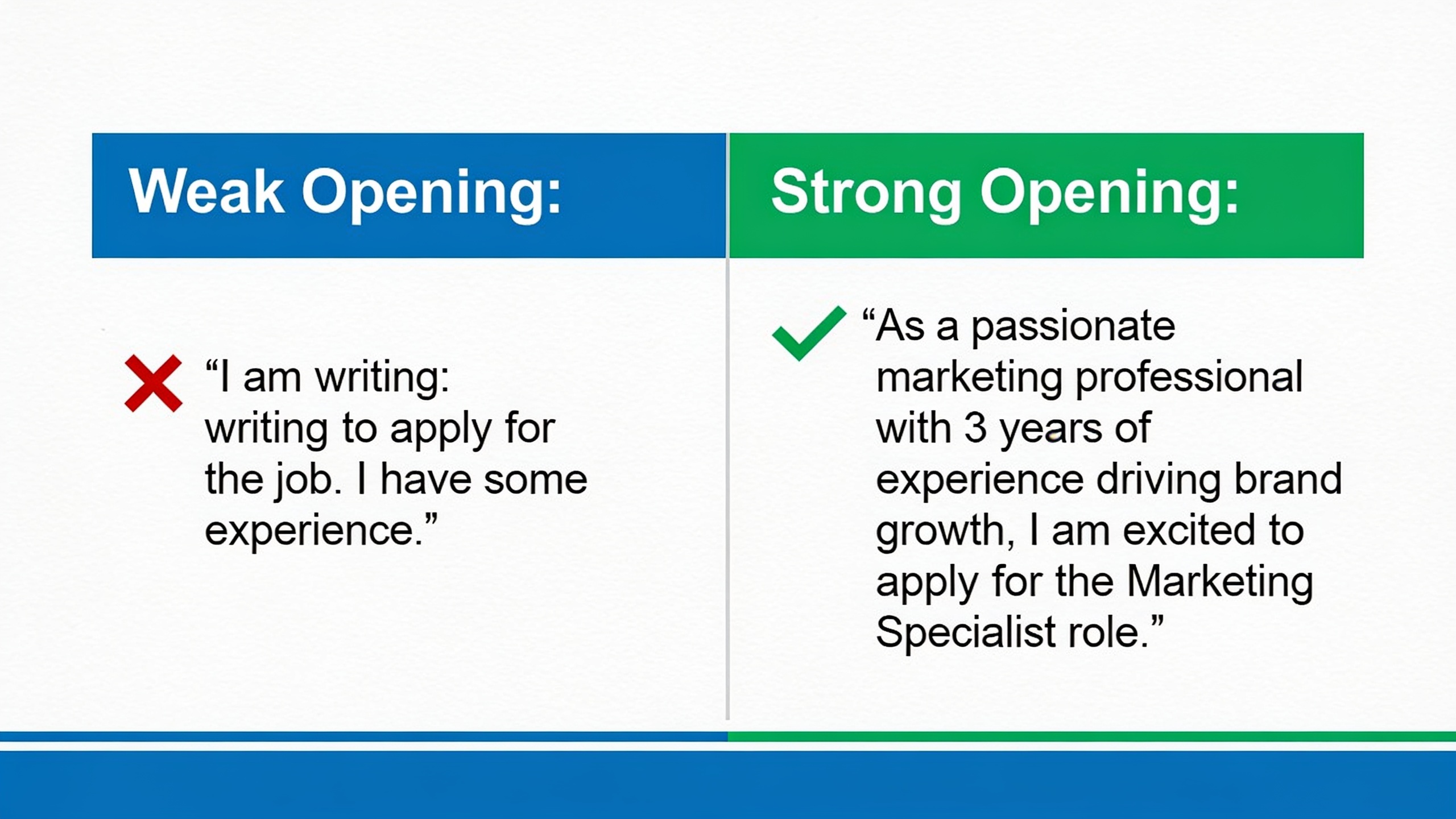
Here's a weak opening, the kind I see constantly:
"I am writing to apply for the position of Marketing Executive that I saw advertised on your website. I believe I would be a good fit for this role."
Snooze. Now here's one that actually works, naming the role, referencing something specific, and dropping a real credential:
"As a marketing coordinator who grew organic traffic by 40% for a D2C skincare brand, I was excited to see the Marketing Executive opening at [Company], especially since your posting leans hard on performance marketing, which is exactly what I've spent the last two years doing."
See the difference? One tells them nothing. The other makes them want to keep reading.
Why Being Specific Beats Sounding Passionate
Recruiters read dozens of letters swearing "I am passionate about this opportunity" with absolutely nothing to back it up. Passion with no proof is just filler, and everyone can smell it. Swap out the empty enthusiasm for a number, a project, a result, even a small one. "Reduced onboarding time by two days" or "managed a team of 4 interns" says way more than "I am a hardworking and dedicated professional." Everyone claims to be hardworking. Show it instead.
Keep the Opening to Three Sentences, Tops
Hiring managers often decide whether to keep reading in about 10 seconds. If your opener runs six or seven sentences, you've probably lost them before you even got to the good part. Cut hard. The details belong in the body, not the intro.
Showing You Fit Without Just Copying Your Resume
You show fit by tying one or two specific wins to the specific requirements in the posting, not by rehashing your entire career. The letter's job isn't to repeat the resume. It's to translate it for this particular employer.
The method I like is dead simple. Reread the job description and figure out the top two or three requirements, and I mean the ones near the top or mentioned more than once, not the tenth bullet nobody cares about. Then for each one, grab a real example from your background that proves you've got it. Write a sentence or two per example, and lead with the outcome, not the task.
So if the posting keeps hammering "experience managing stakeholder relationships," don't just write "I have stakeholder management experience." Boring, and it proves nothing. Try: "In my last role I ran weekly syncs between engineering and sales across three time zones, which cut project delays by roughly 20%."
This is also a spot where a fitment score earns its keep before you even open the document. JobScans lets you upload your CV and get a 0–100 fitment score against a specific job description, which gives you a quick, honest read on which bits of your background actually line up with the role. Handy to know before you decide which achievements to feature.
The Middle Bit: Why This Company
The back half of your body should tackle why this company, not just why this role. Point at something real. A product line, a mission, a recent expansion. Skip the vague flattery like "I admire your innovative culture," because it means nothing and they know it. And if you genuinely can't dig up one specific thing to say after five minutes of poking around their site? That's worth sitting with. Might be telling you something.
The Mistakes Everyone Makes (And How to Stop)
The usual suspects are generic language, going way too long, repeating your resume, and skipping the proofread, and all four are fixable with one quick revision pass before you send. Here's a cheat sheet.
| Common Mistake | Why It Hurts You | Quick Fix |
|---|---|---|
| Generic opening ("I am writing to apply...") | Signals a copy-paste application | Name the role and one specific qualification in sentence one |
| Repeating the resume line by line | Wastes the recruiter's time; adds no new information | Pick 2 achievements and explain their relevance to this job |
| Overly long letter (a full page or more) | Gets skimmed or skipped entirely | Aim for 3-4 short paragraphs, under 350 words |
| No company-specific detail | Reads as mass-applied, not targeted | Reference a product, value, or recent update from the company |
| Leftover template text (wrong company name, "Dear Hiring Manager at [X]") | Immediately signals carelessness | Do a final read-through focused only on names and placeholders |
| Weak closing with no clear next step | Leaves the reader without direction | End with a specific ask, e.g., "I'd welcome the chance to discuss..." |
The Proofreading Pass Almost Nobody Does
Even great writers miss dumb errors after staring at the same paragraph for an hour. Your brain starts autocorrecting what it expects to see. So before you send, read the whole thing out loud, once. It catches clunky phrasing your eyes just glide over when you read silently. And triple-check the company name and role title all the way through, especially if you started from an old letter as a template. That's how the "wrong company name" disaster happens.
Should You Just Use an AI Cover Letter Generator?
An AI cover letter generator is a genuinely smart starting point when you're firing off applications fast, but it works best as a first draft you personalize, not something you submit as-is. The time savings are real. Instead of blowing 45 minutes writing from scratch for every single role, you generate a structured draft in a few minutes and pour the rest of your time into the parts that actually matter: the company details, the tone, and the one or two wins you want front and center.
This is especially useful if you're applying at volume, like a new grad casting a wide net or someone changing careers across a few different industries. JobScans has a feature that generates cover letters right alongside its resume-tailoring tools, and it's free to start, so if you just want to see whether an AI draft actually speeds up your workflow, it costs you nothing to poke around.
What the AI Can Do, and What It Can't
An AI generator is great at structure, keeping the tone consistent, and spitting out a fast first draft from your resume and the job description you feed it. What it can't do, at least not on its own, is know which achievement means the most to you, or pick up on some quirk of the company culture you'd only learn from research or from actually talking to someone who works there. Think of the AI draft as scaffolding. It gets you past the blank page, which is honestly half the battle, but it still needs your fingerprints on it before you hit send.
Pairing the AI Draft With Your Fitment Score
Since JobScans also gives you a fitment score based on your CV against a specific posting, you can run that as a diagnostic before you even generate the letter. If the score flags a gap, maybe a keyword or a skill the posting really cares about, you get to decide whether to tackle it head-on in the cover letter (say, by pointing to a related project or a transferable skill) instead of just leaving it hanging there awkwardly.
And if you're weighing up which platform to build your whole job search around, it's worth seeing how different tools handle resume and cover letter support. This comparison of JobScans vs Naukri and which one helps you land jobs faster digs into how the two differ on application tooling, not just who has more listings.
Cover Letter Advice Depending on Where You Are in Your Career
What you emphasize in a cover letter shifts depending on your stage. New grads have to make up for thin experience, career changers have to build a bridge between two worlds, and veterans have to avoid sounding like a broken record across a long history.
If You're a Recent Grad
Applying for your first proper job and you don't have years of achievements to lean on? Totally normal. Don't panic. Lean on what you do have. Academic projects with real outcomes count, so a capstone, a hackathon placement, a research paper, all of it works if you frame it around skills and results instead of just naming it. So do internships, even short ones. A four-week stint where you actually owned one task beats a fuzzy "gained exposure to the industry" every time. And when you talk about soft skills, back them with an example. Don't say "strong communication skills," say you presented a group project to 50 classmates. Concrete always wins.
If You're Switching Careers
Moving from one industry to another? Your letter has to actually build the bridge instead of hoping the recruiter connects the dots for you (they won't, they're busy). Name the pivot straight up: "After five years in retail operations, I'm moving into supply chain analytics because..." then give a real reason and a skill that carries over, like inventory forecasting or vendor negotiation. Say it out loud. It reads as confidence, not confusion.
If You're a Seasoned Pro
Ten-plus years in? Fight the urge to cram your whole career into four paragraphs. Pick the two or three roles or projects that matter most for this job and let the resume handle the rest. A letter that tries to squeeze 15 years into half a page ends up vague everywhere and specific nowhere, which is the opposite of what you want.
Frequently Asked Questions
How long should a cover letter actually be?
Most hiring managers want three or four short paragraphs, somewhere around 250 to 350 words, fitting on half a page. Go longer and you're basically inviting them to skim instead of read, especially when they've got dozens of applications for one posting stacked up.
Do I really need a different letter for every job?
Yeah, you do. Reusing the exact same letter across applications is one of the quickest ways to get filtered out, because recruiters can usually smell when it wasn't written for them. You don't have to start from zero every time, but do swap the opening line, the featured achievement, and the company-specific bit for each one.
Is it okay to use an AI generator instead of writing it myself?
Using an AI generator for a first draft is completely reasonable, especially when you're applying to a bunch of roles in a short window. It works best when you treat the output as a starting point and then personalize the details, the company name, the specific win, the tone, rather than firing off the raw AI version unedited.
What goes in the first line?
Name the exact role you're applying for and hint at one concrete qualification or achievement that ties to it. Whatever you do, don't open with a limp "I am writing to express interest" that has nothing behind it.
Should the letter repeat what's already on my resume?
No. A cover letter should interpret your resume for the specific job, not recite it. Grab one or two achievements that best match the posting's top requirements and explain the context or the result behind them, instead of just re-listing the task.
So, Putting It All Together
Writing a cover letter that gets noticed really comes down to a handful of habits you can repeat every time. Open with something specific instead of generic. Connect your background to the actual job requirements, not your entire life story. Keep it short. And proofread with fresh eyes before you send. None of this needs some natural gift for writing. It needs you to read the job description carefully and be ruthless about cutting anything that doesn't help your case for this role. Whether you write every letter by hand or start from an AI draft to save time, that final personalization pass is the thing that quietly moves you from "skimmed" to "shortlisted." That's the whole game.