
So what does "tailor" even mean here? It means tweaking the language, keywords, order, and emphasis of your resume so it speaks to one specific job posting instead of describing your career in vague, everybody-could-say-this terms. I'm going to walk you through exactly how, step by step, and show you where a tool like JobScans can shave off some of the tedium without making things worse.
Table of Contents
- What Does It Mean to Tailor Your Resume?
- Why You Need to Customize Your Resume for Every Job
- How to Tailor Your Resume for Every Job Application: A Step-by-Step Process
- Manual Tailoring vs. AI-Assisted Tailoring
- How JobScans' Auto-Tailor Feature Speeds Up the Process
- Common Mistakes When You Customize a Resume for a Job
- Tailoring Your Resume at Different Career Stages
- Frequently Asked Questions
What Does It Mean to Tailor Your Resume?
To tailor a resume is to rewrite specific chunks of it (the summary, the skills list, the bullet points, sometimes even the section order) so they line up with the language and priorities of a particular posting, instead of reusing one frozen document for everything. And no, this isn't about lying or inventing a career you never had. It's about surfacing the true parts of your background that matter most for this job and shoving the less relevant stuff further down, or off the page entirely.
Think of your full work history as raw material. A generic resume dumps all of it out in one fixed shape and hopes for the best. A tailored one takes the same material and reshapes it around what a specific hiring manager is scanning for.
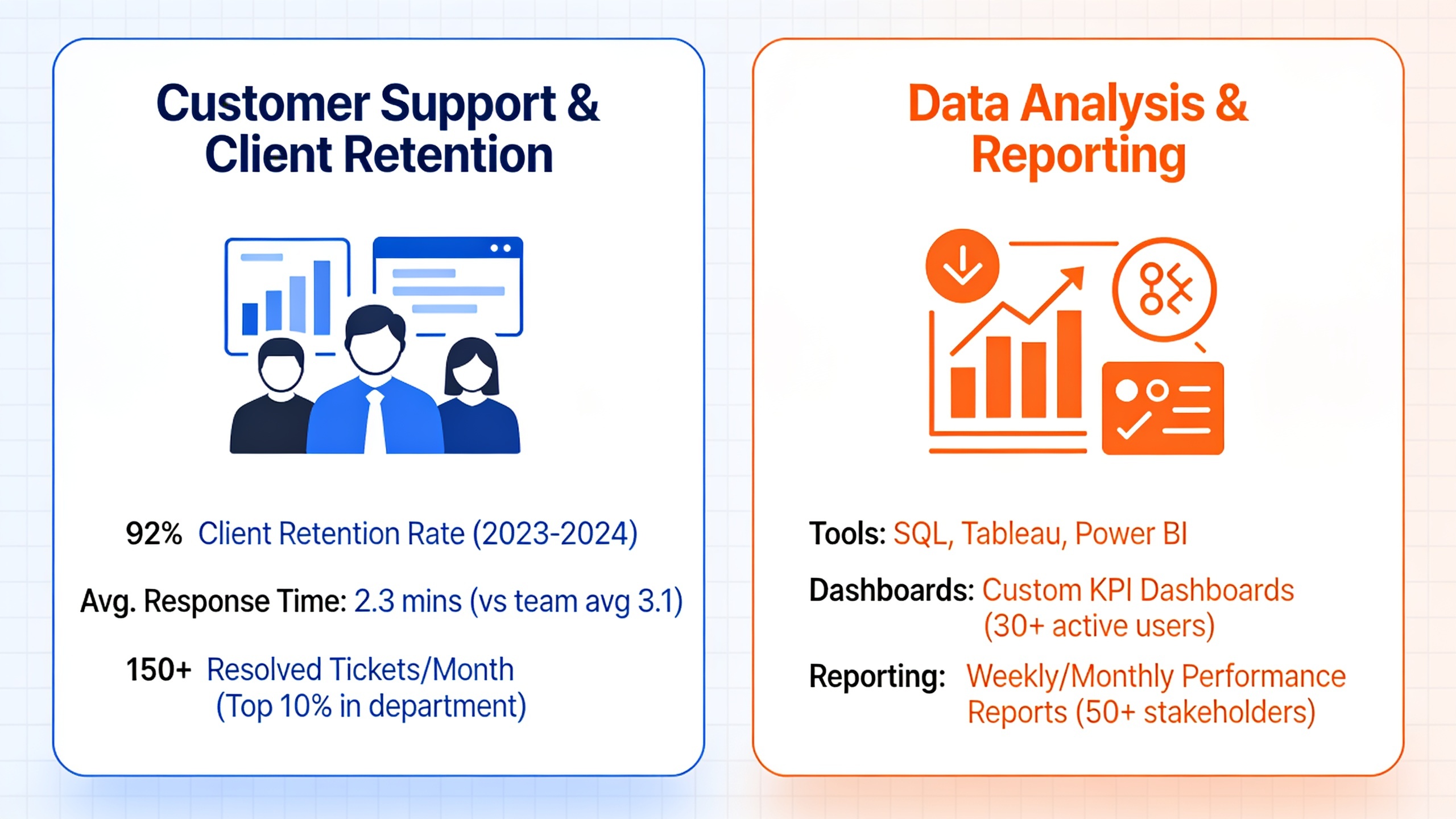
Say you've done both customer support and data analysis. A resume aimed at a customer success role would lead with support metrics and client retention numbers. The version for an analytics role? That one leads with your reporting tools, your dashboards, your data accuracy work. Same person, same career, two very different documents.
This matters because almost every company now runs an Applicant Tracking System (ATS), software that scans, parses, and ranks your resume by keyword match and formatting before a single human lays eyes on it. A resume that doesn't echo the terms in the job description can get quietly filtered out. Doesn't matter how qualified you actually are. The machine never passed you along.
Why You Need to Customize Your Resume for Every Job
You need to customize your resume for every job because both the hiring manager and the ATS are hunting for tight alignment between the posting and your application, and a generic resume almost never delivers that convincingly. Two jobs with nearly identical titles (say, "Marketing Coordinator" at two different companies) can demand completely different priority skills, tools, and wins depending on the industry, the team size, and how established the company is.
Here's the uncomfortable part. Recruiters spend maybe a few seconds on that first scan before deciding whether you're worth a real read. So your most relevant stuff needs to be right there, up top, not buried in paragraph four. If your opening line brags about "5 years of diverse professional experience" instead of naming the skills the posting actually asks for, you're basically asking the recruiter to do the matching work for you. Most won't. Why would they, when there's a stack of other resumes right there?
And that stack is real. Popular postings, especially entry-level ones, can pull in hundreds of applicants inside a few days. In a crowd like that, a resume that mirrors the job description's own vocabulary has a structural edge over one that just lists a career history in neutral terms. This is exactly why every career counselor and recruiter keeps hammering the same point: customize per job, don't mass-apply with one version. Fewer applications, higher response rate. The math works out in your favor.
How to Tailor Your Resume for Every Job Application: A Step-by-Step Process
Tailoring a resume for a specific job boils down to four repeatable steps: read the posting closely, match keywords honestly, reorder your content by relevance, and rewrite your summary to fit. Do this consistently, even in a rushed 15 to 20 minute window, and you'll end up with something noticeably stronger than the one-size-fits-all approach.
Step 1: Read the Job Description Like a Detective
Before you touch your resume, read the posting twice. Once to get the general shape of the role, and once specifically hunting for repeated words, hard requirements, and phrases that pop up in both the "Responsibilities" and "Requirements" sections. Those repeated terms? That's usually the exact language both the ATS and the hiring manager are anchored to. Copy them into a separate note so you've got a working checklist.
Pay attention to the "required" versus "preferred" split, too. Required skills should show up prominently if you honestly have them. Preferred ones are only worth including if you can actually back them up with real experience, even briefly.
Step 2: Match Keywords Without Keyword Stuffing
With your list of key terms in hand, go through your resume and spot which ones are missing. The goal is to work in the employer's exact phrasing naturally. If they say "cross-functional collaboration" and you wrote "worked with other teams," change it to match. ATS parsing is often stubbornly literal, not clever, so a synonym doesn't always count.
Now, do not paste a wall of keywords into a hidden section or use white text to game the system. Modern ATS platforms and human reviewers both catch this, and it reads as sketchy rather than diligent. The better move is folding those terms into real bullet points about real work, so the keyword match is also an honest match. This is also where knowing your overall alignment helps. You can see how closely your existing resume already lines up with a posting by checking your résumé's fitment score, which I get into in What Is a Resume Fitment Score and Why It Matters, before you decide which sections need the heaviest surgery.
Step 3: Reorder and Reframe Your Experience
Not every past role deserves equal real estate on every version. Applying for a project management role, and your last job was 70% project coordination and 30% general admin? Lead those bullet points with the coordination work and shrink (or drop) the admin stuff. The underlying history doesn't change. Only what you choose to spotlight does.
Same logic applies to the order of your jobs and skills. If an older role fits the target position better than your most recent one, consider a short "Relevant Experience" block near the top, followed by a leaner "Additional Experience" section further down. Sometimes strict reverse-chronological order just buries your best match, and there's no rule saying you have to bury it.
Step 4: Rewrite Your Summary or Objective
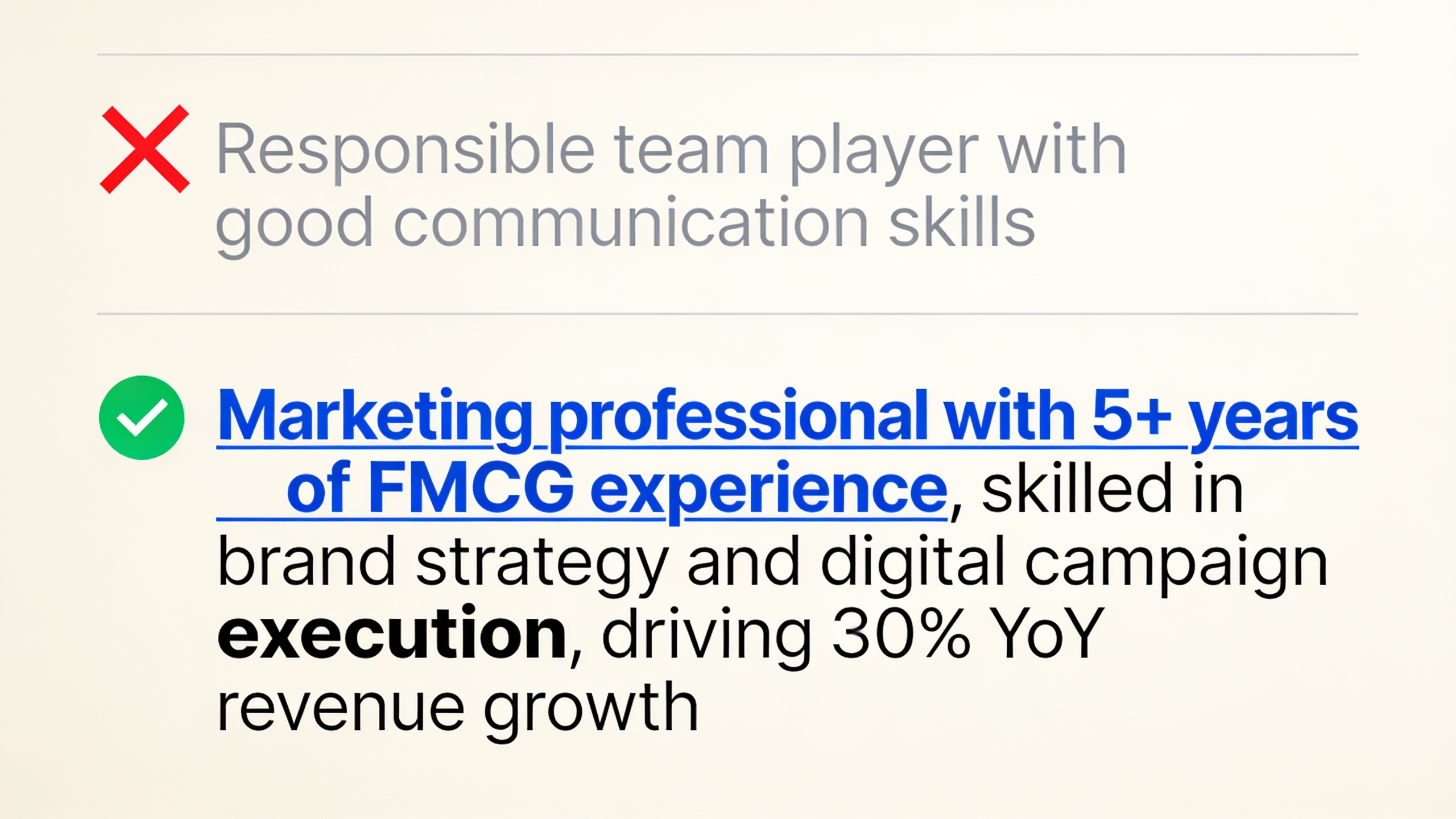
Your summary, that two-or-three-sentence block up top, is the single most important thing to customize, because it's often the first and sometimes only part a recruiter reads carefully. A good tailored summary names the specific role or field you're going for, mentions one or two of your strongest matching qualifications, and borrows language straight from the posting.
Compare the generic version, "Motivated professional with experience in various administrative and coordination tasks," to a tailored one: "Operations coordinator with 3 years of experience managing vendor logistics and scheduling for teams of 15+, seeking to bring process-improvement skills to a fast-paced supply chain role." The second tells the reader, in one breath, that you're a plausible fit for this exact job. The first tells them nothing.
Manual Tailoring vs. AI-Assisted Tailoring
Manual tailoring gives you total creative control but eats up a lot more time per application, while AI-assisted tailoring speeds through the repetitive parts (keyword spotting, first-draft rewrites) but still needs a human eye before you hit submit. Neither one wins in every scenario. Honestly, the right pick depends on how many applications you're firing off and how much time you can realistically spare for each.
| Aspect | Manual Tailoring | AI-Assisted Tailoring |
|---|---|---|
| Time per application | Typically 30–60+ minutes if done thoroughly | Significantly faster for the first draft, since keyword matching and rewrites are generated automatically |
| Keyword accuracy | Depends on how carefully you compare your resume to the posting yourself | Tools can systematically scan the job description for repeated terms and required qualifications |
| Personal voice and nuance | Full control over tone, phrasing, and which achievements to highlight | May require light editing afterward to sound natural and specific to you |
| Best suited for | A small number of high-priority applications where every word matters | Applying to many roles in a short time frame, or a starting point that you refine manually |
| Risk of error | Human oversight, but can miss ATS-specific formatting or missed keywords | Needs a final human check to confirm accuracy and avoid generic-sounding output |
In practice, most people land somewhere in the middle. They use an AI tool to spit out a tailored first draft fast, then spend ten minutes personalizing the language so it doesn't read like it came off an assembly line. That hybrid thing tends to get you the speed of automation plus the authenticity of something a human actually touched.
How JobScans' Auto-Tailor Feature Speeds Up the Process
JobScans is an AI-driven job-search platform built for the Indian job market. You upload your CV and instantly get a fitment score between 0 and 100 for a specific posting, plus tools to auto-tailor your résumé and generate a matching cover letter. Instead of manually cross-referencing your resume against a job description line by line (which, let's be real, is soul-crushing after the third application), you can see at a glance how closely your document already matches before deciding how much rework it needs.
The auto-tailor feature pushes that comparison further by adjusting your résumé's content in response to a specific posting. That's genuinely handy when you're applying to several similar-but-not-identical roles in one week and can't face starting each version from a blank page. And because the fitment score and the tailoring tool are wired together, you actually get feedback: upload your resume, see your score, tailor it, watch whether the score climbs. Way better than tailoring blind and crossing your fingers. It's free to start, so it's a pretty low-risk way to test whether AI-assisted tailoring fits your workflow before you sink more time into it.
One thing I want to be honest about, though. No auto-tailor tool is magic. It can find keyword gaps and restructure content fast, but it can't conjure experience you don't have, and it still wants a quick human proofread before you send anything. Same as a spellchecker, useful, but no substitute for reading the thing yourself one last time.
Common Mistakes When You Customize a Resume for a Job
The most common mistake is over-editing the surface language while leaving the underlying structure and emphasis untouched. You end up with a resume full of the right buzzwords that still doesn't actually highlight your relevant experience. Swapping in keywords without changing what you emphasize is a half-measure, and both the ATS and the humans can smell it.
Another one I see constantly: people tailor the summary and then completely forget the bullet points underneath. If your opening brags about "data visualization" skills but not a single job below mentions a dashboard, a chart, or any reporting tool, the mismatch is glaring. That actually hurts your credibility. Worse than not mentioning it at all.
Then there's the opposite failure, going too far and inventing or inflating skills just to hit the keyword list. This is risky ethically and practically. Interviewers probe for specifics, and a candidate who can't back up a listed skill with a real example loses trust fast. You do not want to be that person sweating through a question about a tool you've never opened.
Formatting sloppiness is a smaller but persistent gremlin. When people rush to tailor a bunch of resumes in one sitting, they end up with mismatched fonts, inconsistent bullet styles, or leftover phrases from a previous version that make zero sense in the new context. A full read-through before submitting (not just a skim of the parts you edited) catches most of it.
And finally, tons of people tailor the resume beautifully and then attach an identical, generic cover letter to every single application. Or skip it entirely. That kind of undoes the whole effort. If you're going to sweat over the resume, spend a similar bit of care on a short, specific cover letter that reinforces the same points. Otherwise you're leaving value on the table.
Tailoring Your Resume at Different Career Stages
How you tailor a resume shifts a lot depending on where you are, fresh grad with barely any work history, mid-career pro pivoting into a new industry, or someone coming back after a gap. Each situation calls for a different balance between the skills you've already got and the ones you're trying to show potential for.
Recent Graduates
If you're a recent grad chasing your first full-time role, you don't have years of matching job titles to lean on. So tailoring means pulling relevant coursework, internships, class projects, and part-time gigs into the language of the posting, instead of presenting them as "just a student thing." A marketing internship where you ran a student club's social media can be described with the same metrics-driven language a professional would use ("grew engagement by X%," "coordinated content calendar across 3 platforms"). For a fuller walkthrough of building a first resume from thin experience, the Fresh Graduate's Guide to Landing Your First Job in India covers how to frame academic and internship work convincingly for entry-level roles.
Career Changers
Switching industries or functions entirely? Then tailoring becomes less about swapping keywords and more about translating your existing skills into the vocabulary of the new field. Someone moving from teaching into corporate training, for instance, should reframe "lesson planning" as "curriculum design" and "classroom management" as "stakeholder engagement" or "group facilitation," because those are the terms a hiring manager in the new field is actually scanning for. Career changes sometimes come bundled with a location move, too, and folks relocating for a role often end up house-hunting in parallel with job-hunting. Platforms like Viviendalista can help with that side of things, letting you scope out neighborhoods and rental listings while you finish up your applications.
Returning to the Workforce
Coming back after a break? Tailoring here often means addressing the gap indirectly, leading with skills and outcomes rather than dates, and including any freelance, volunteer, or consulting work you did during the break if it's relevant. A short, confident line in the summary, something like "returning to full-time work after a family care break, bringing 6 years of prior experience in X," tends to read a lot better than an unexplained gap you're hoping nobody notices. They notice. Just get ahead of it.
Frequently Asked Questions
Do I really need a different resume for every single job, or just for different types of roles?
You don't need a totally fresh document for every posting, but you do need to adjust the summary, keywords, and emphasis each time. Even small shifts in job title language or required skills can meaningfully change what you should be highlighting. A practical middle ground a lot of people use: keep two or three "base" versions for different role types, then spend a few minutes tailoring each one further for the specific posting.
How long should tailoring a resume actually take once I have a process?
With a repeatable checklist (scan the description, compare keywords, rewrite the summary, reorder the bullets) most people can tailor an existing resume in 15 to 30 minutes, especially once they've built a solid base to work from. Tools that auto-generate a first draft can shave that down further, though a final proofread is always worth the extra couple of minutes.
Will an ATS reject my resume if I don't use the exact same words as the job posting?
Not necessarily, but a lot of ATS platforms lean hard on literal keyword matching rather than understanding synonyms, so using the posting's exact phrasing for critical skills reduces your odds of being filtered out over a mismatch that isn't really a mismatch. It's generally safer to mirror the posting's specific terms for your core, truthful qualifications than to assume the software will treat a similar-but-different phrase the same way. It usually won't.
Is it dishonest to tailor a resume so heavily for each job?
No. Tailoring is about emphasis and language, not fabrication. You're presenting your real, verifiable experience in whichever framing fits the role best, the same way you'd naturally describe your background differently to a technical interviewer versus a client. The line only gets crossed when someone adds skills, titles, or achievements that aren't true. That's a completely separate (and much riskier) issue than simply reordering or rephrasing real experience.
Can a fitment or matching score actually predict whether I'll get an interview?
Think of a fitment score as a proxy for how closely your resume's content and language line up with a specific posting, a useful directional signal for spotting gaps before you apply, not a guarantee of an interview. Hiring decisions also hinge on stuff a score can't measure: competition, how you perform in the interview, whether someone inside the company vouches for you. The score gets your foot toward the door. The rest is on you.
Tailoring your resume for every application isn't about writing a brand-new document each time. It's about building one strong base resume and then deliberately reshaping the emphasis, the language, and the order to match what each specific employer is actually after. Whether you do that by hand with a highlighter and the posting open in another tab, or speed it up with a tool that scores and adjusts your resume automatically, the goal is the same: make it as easy as humanly (or robotically) possible for a recruiter to see why you're a strong fit for this particular role.