
And look, switching careers in your 30s is a completely different animal than doing it at 22. You've probably got a mortgage or rent that isn't going anywhere, a professional identity welded to your current job title, and roughly zero patience for those open-ended "let me just wander and see what happens" phases. Which is exactly why winging it doesn't cut it anymore.
Table of Contents
- Why Career Change at 30 Feels Different
- How Do You Know It's Time for a Career Change?
- Step 1: Conduct a Honest Skill-Gap Analysis
- Step 2: Reposition Your Résumé for a New Industry
- Step 3: Build Bridges Before You Jump
- What Does Switching Careers in India Actually Look Like?
- Step 4: Manage the Financial and Emotional Transition
- Common Career Change Paths at 30: A Comparison
- Frequently Asked Questions
Why Career Change at 30 Feels Different
A career change at 30 feels harder than at 22 mostly because you're now dragging around accumulated identity, income expectations, and sometimes people who depend on you, none of which a fresh grad has to think about. That's not a disadvantage, by the way. It's just a different math problem.
Here's what I mean. At 22, a wrong turn costs you a year, maybe. No big deal. At 30, you've usually built up seven or eight years of professional equity. A title, a network, a salary band, that home loan EMI that shows up every month whether you like it or not. Changing direction means knowingly trading some of that away for a fresh start somewhere unfamiliar. That trade can absolutely be worth it. But it has to be a decision, not a reaction to a bad week.
Now the upside, and it's a big one. By 30 you've got stuff graduates simply don't have yet: project management instincts, the ability to actually communicate with stakeholders without panicking, negotiation skills, and a real track record of shipping results. The whole point of doing this well isn't to throw those eight years in the bin. It's to translate them into something your new industry actually wants to pay for.
How Do You Know It's Time for a Career Change?
You know it's time for a career change when your unhappiness is about the work itself, not just a bad boss, a rough quarter, or a promotion that never came. Figuring out whether you've got a fixable job problem or a wrong-career problem is honestly the first real fork in the road, and people skip it constantly.
So before you go anywhere near your résumé, sit with three questions. First: if you took the same job at a different company, would that genuinely light you up? Or does the thought of doing the same core tasks somewhere else still feel like nothing? Second: is there a subject or skill you keep drifting toward on your own time, like coding side projects, writing, analytics, teaching, whatever, that quietly tells you where your energy actually wants to go? And third: have you just outgrown the ceiling of your current path, whether that's growth, money, or plain relevance, especially given how fast some sectors (tech, data, renewable energy) are pulling ahead of others?
If your gut answers keep pointing at the work rather than the stuff surrounding the work, congratulations, sort of. You're probably looking at a genuine career change and not just a rough patch a new employer could fix.
Step 1: Conduct a Honest Skill-Gap Analysis
A skill-gap analysis is just a structured comparison between what your target role demands and what you can currently do, so you can see exactly what you need to learn before anyone will take you seriously as a candidate. And yes, this comes before the résumé rewrite, not after. It decides what story your résumé even needs to tell.
Map the target role's requirements first
Go pull five to ten actual job postings for the role you want. Not just the title, the real listed responsibilities and requirements. Then watch for what shows up over and over. Say you're going from operations into product management. You'll probably see roadmap prioritization, cross-functional communication, and some basic data literacy (SQL, analytics dashboards) coming up again and again. That repeating stuff? That's your target skill list. Done.
Audit what you already have
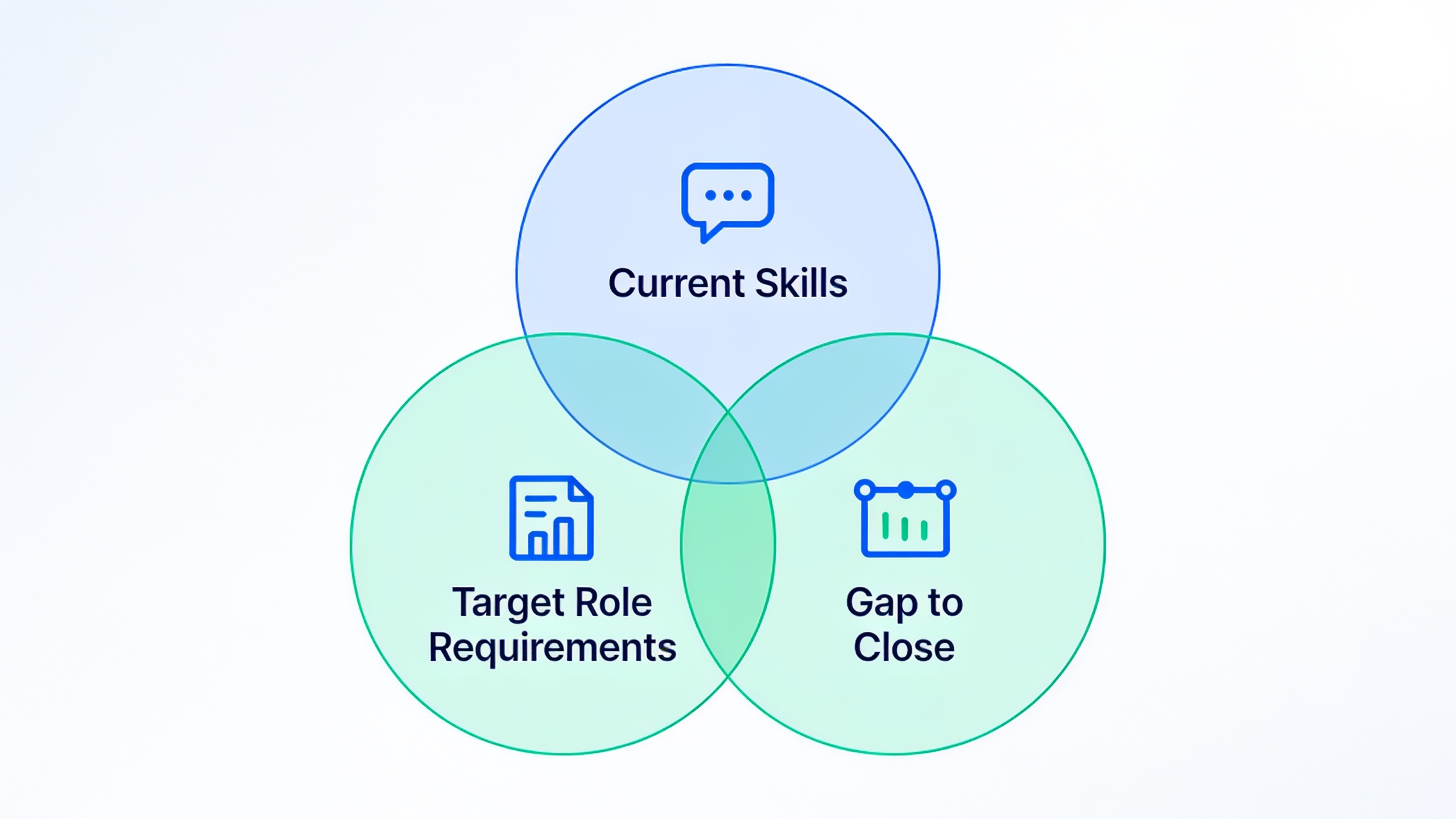
Now go down that list and tag each one honestly: "I've got this," "I've got a cousin of this," or "nope, don't have it." Here's where a lot of people breathe a sigh of relief, because the gap is usually smaller than the fear made it out to be. A marketing manager moving into UX research, for instance, often already has strong interviewing chops, synthesis skills, and the ability to present to stakeholders without breaking a sweat. What's actually missing might just be a couple of tools like Figma or a grip on usability-testing frameworks. That's it.
Prioritize the gaps that actually block hiring
Not every gap needs a certificate slapped on it. Some you can close with a short course, a personal project, or volunteering. Others genuinely need formal credentials (finance, healthcare, and certain engineering-adjacent roles tend to live here). Rank your gaps by how often they show up as a hard "must-have" versus a soft "nice-to-have," and go after the must-haves first. Don't waste three months learning something nobody's actually gatekeeping on.
This is also a smart moment to check where you stand numerically, not just in your own head. Tools that spit out a fit score against a specific job description, like the feature JobScans offers where it scores your CV against a posting on a 0–100 scale, can show you in cold, concrete terms where your current résumé already lines up and where the holes are widest. Better to know that now than after you've sunk months into upskilling the wrong thing.
Step 2: Reposition Your Résumé for a New Industry
Repositioning your résumé for a career change means rebuilding it around transferable achievements and industry keywords, not just rattling off your job history in order. A résumé that reads beautifully for your old field can quietly sabotage you in a new one, because hiring managers are skimming for relevance in something like the first six seconds. You don't get a second pass.
Lead with a summary that reframes your identity
Skip the generic objective statement. Please. Instead, open with two or three lines that spell out the connection between where you've been and where you're headed. Something like: "Operations manager with 8 years leading supply-chain teams, now applying data-driven process optimization skills to product analytics roles." That one sentence does the translating so the recruiter doesn't have to squint and guess.
Rewrite your bullet points around transferable outcomes
Run every single bullet under your old roles through one question: does this prove a skill the new industry cares about? A sales manager moving into customer success, for example, should push retention numbers, renewal negotiations, and client relationship management to the front, not raw revenue figures. Because that's the language customer success actually speaks. Same career, different vocabulary.
Use industry-specific keywords deliberately
Both the applicant tracking systems and the actual humans are scanning for the target field's terminology. Moving into digital marketing? Words like "conversion rate optimization," "attribution modeling," or "CAC/LTV" quietly signal you know the world, even if your last title had nothing to do with it. This is where auto-tailoring tools genuinely earn their keep. Instead of hand-rewriting your résumé for every single application (soul-crushing, I promise), a platform that auto-tailors your résumé to a specific job description can shift the phrasing and emphasis to mirror the posting while keeping your actual experience honest.
If you're further back on this road and still building your very first professional résumé rather than reshaping an existing one, go read this fresh graduate's guide to landing your first job in India. A lot of the fundamentals in there (clarity, quantified achievements, formatting for ATS systems) apply just as much to career switchers rewriting their story from a blank page.
Don't ignore your cover letter
Honestly, the cover letter was practically invented for the career changer. Your résumé shows what you did. The cover letter is where you explain why the pivot, and why you're credible despite it. It's the one place you can directly answer the "why now?" question the recruiter is silently asking while they read. Which is exactly why generating a tailored one per application, instead of copy-pasting the same tired template, matters more during a transition than at basically any other point in your career.
Step 3: Build Bridges Before You Jump
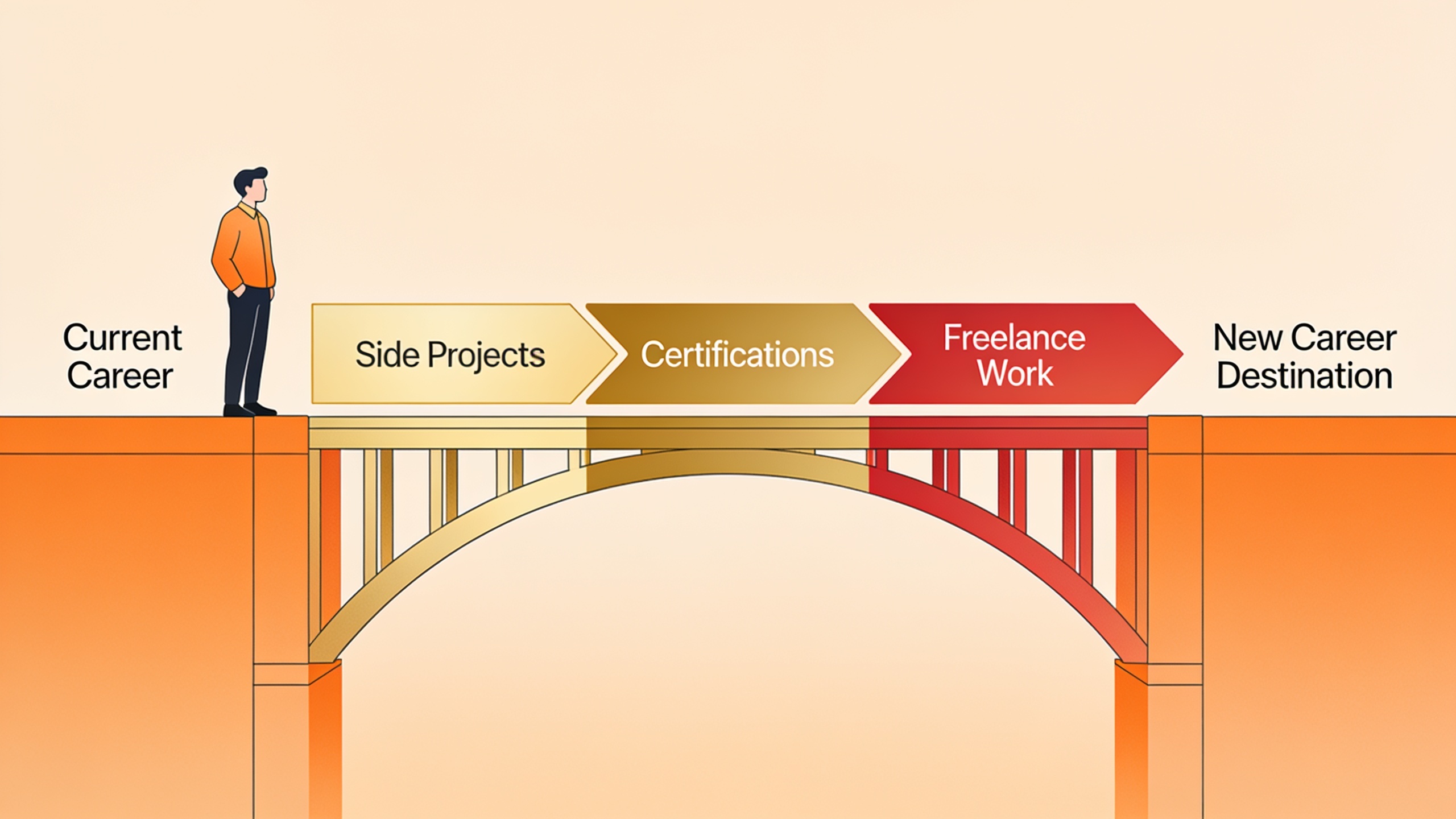
The safest way to switch careers at 30 is to build a bridge first: a project, a certification, a freelance gig, an internal transfer, anything that gives you real, verifiable experience in the new field before you fully leap. Jumping cold with zero proof you've ever touched the new domain is the riskiest and slowest way to get hired. Don't do that to yourself.
Your first move should be looking for internal transfers. If your current company has teams heading in the direction you want, an internal jump is usually the least painful bridge there is. Your salary keeps flowing, the organization already trusts you, and you rack up real experience in the new function, the exact kind of experience an outside employer would demand proof of before they'd even interview you.
Next up, side projects and freelance work. Even unpaid or barely-paid work in the new field gives you something to point at. A finance person eyeing content or marketing might start a niche newsletter or run social media for a small local business. A teacher moving into corporate training might design and deliver one workshop. The money isn't the point. The portfolio piece and the talking point are.
And then there's certification, but be picky about it. Some transitions really do need the credential. Data analytics is often smoothed along by recognized certs in SQL, Python, or tools like Power BI/Tableau; a move into HR can benefit from an HR-specific certification. But certifications matter most where the industry uses them as a hiring filter, and matter way less where employers would rather see a portfolio. Read the room before you spend the money.
What Does Switching Careers in India Actually Look Like?
Switching careers in India usually means dealing with a job market that leans harder on networks and referrals than a lot of Western ones, plus a strong cultural and family expectation around job stability that can make a pivot feel riskier than the numbers actually say it is. If a career change guide ignores that local reality, it's kind of useless for Indian professionals.
The market here has also been moving fast. Sectors like IT services, EdTech, fintech, renewable energy, and healthcare have kept hiring even while some old-guard industries slowed down, which means the "safe" industry from a decade ago isn't automatically the safe one now. That volatility cuts both ways. It creates genuine openings for switchers willing to reskill toward the growing sectors, but it also means you actually have to do your homework on an industry's real hiring trends, not just its reputation. Reputation lags reality by years.
Networking, though, is the big one. In the Indian hiring context it carries outsized weight. Referrals, alumni networks, and thoughtful LinkedIn outreach to people already working in your target field tend to crack open doors that cold applications just bounce off of. If you're going from, say, a core engineering role into product management, messaging product managers at companies you admire, with one specific, well-researched question instead of a lazy "any advice?", gets meaningfully better responses. People can smell effort.
It's also worth wrapping your head around how hiring itself is changing, because AI now sits on both sides of the table. Recruiters use it to screen, candidates use it to prep. This piece on how AI is actually changing job hunting in India is a solid read if you want to understand what's happening on the recruiter's end while you're busy repositioning yourself on yours.
Step 4: Manage the Financial and Emotional Transition
Managing the money side of a career change means building a runway, usually several months of expenses, before you hand in your notice. Managing the emotional side means making peace with the fact that a temporary drop in title or seniority is often just the entry fee for a new field. Both of these need a plan. Optimism alone won't cut it.
Start with the runway. If your transition involves any income gap at all, whether from studying, freelancing, or just job hunting, add up your essential monthly expenses and multiply by a conservative buffer before you walk away from a steady paycheck. Almost everyone underestimates how long a job search in an unfamiliar industry takes, and it's not because they're dumb. It's because they don't yet have the network or the pattern recognition they'd have in their old field. You're rebuilding both from scratch.
Then there's the ego part, which nobody likes talking about. It's pretty common (not universal, but common) for a switcher to enter a new field at a slightly lower title or salary than they had, in exchange for the growth runway ahead. Naming that honestly to yourself, and to family who might be quietly reading your salary as a scoreboard, softens the blow when the first offer isn't a lateral-or-better move. Expect it and it stings less.
And protect your head during all this. A career transition search is genuinely stressful and often drags on for months, and it's frighteningly easy to let it eat every waking hour of your life. Small rituals that mark the end of a day help more than they sound like they should. Even something as small as lighting one of the hand-poured soy candles from a seasonal collection as you shut the laptop for the night can draw a line between "job search mode" and "off duty." That boundary matters over a long haul.
Common Career Change Paths at 30: A Comparison
Different kinds of career changes come with wildly different difficulty levels, timelines, and financial risk. The table below lays out four common patterns people in their 30s tend to follow, based on the general shape of each path.
| Career Change Type | Typical Timeline | Financial Risk | Skill-Gap Size | Best Bridge Strategy |
|---|---|---|---|---|
| Same industry, new function (e.g., sales → customer success) | 2–4 months | Low | Small | Internal transfer or lateral pitch |
| Adjacent industry, similar function (e.g., banking ops → fintech ops) | 3–6 months | Low–Medium | Small–Medium | Targeted networking, sector-specific keywords |
| Different industry, same function (e.g., HR in retail → HR in tech) | 4–8 months | Medium | Medium | Portfolio of function-specific results |
| Complete pivot (e.g., engineering → UX design) | 6–12+ months | Medium–High | Large | Certification + freelance/portfolio projects |
One caveat: these timelines and risk levels are general patterns tied to the nature of each transition, not promises. Your actual outcome hinges on your industry, your location, how strong your network is, and how sharply you aim your skill-gap efforts. Two people doing the "same" pivot can land months apart.
Frequently Asked Questions
Am I too old to switch careers at 30?
Nope. Thirty is a really common and honestly advantageous age to change careers, because you've usually got enough experience to bring transferable skills into a new field while still having decades of runway left. The thing you're adjusting for isn't age itself. It's planning around your financial commitments and being deliberate about which of your existing skills actually carry over.
How long does a career change usually take?
It swings a lot depending on how big the skill gap is between where you are and where you want to be. A same-industry functional switch might take just two to four months from "I've decided" to a signed offer, while a full pivot into an unrelated field with a big gap can realistically run six months to over a year, once you fold in upskilling, networking, and the search itself.
Should I quit first, or try to switch while I'm still employed?
Transitioning while you're still employed is generally the lower-risk move, since it keeps your income and stability intact while you build bridge experience, network, and test whether you actually like the new field through side projects or courses. Quitting first is sometimes necessary for intensive, full-time reskilling programs, but if you go that route, do it with a calculated financial runway and not an open-ended "we'll see."
How do I explain a career change to a recruiter or in an interview?
Frame it as a deliberate, logical progression, not a reaction to hating your old job. Focus on what pulled you toward the new field and which of your existing skills transfer straight over, rather than dwelling on everything you disliked before. A tight, forward-looking story backed by real evidence (a side project, a certification, some freelance work) lands so much better than a vague "I just wanted a change." Trust me, they've heard the vague version a thousand times.
Do I need to redo my whole résumé, or can I just tweak it?
You'll need more than a tweak. The summary, the way your bullets are framed, and your keyword choices should all shift to spotlight transferable achievements relevant to the new field, even though the underlying facts of your history stay exactly the same. And since this really has to happen differently for each application, a tool that checks your résumé's fit against a specific posting and auto-tailors the language saves you a genuinely absurd amount of time versus rewriting by hand for every role.
---
A career change at 30 isn't some dramatic leap of faith. It's really just a sequence of calculated steps: figuring out your real motivation, closing the specific gaps that actually matter, reshaping how your experience reads, and giving yourself enough financial and emotional cushion to breathe along the way. Take it one deliberate move at a time, and at some point the whole thing quietly stops feeling like a risk and starts feeling like a plan.