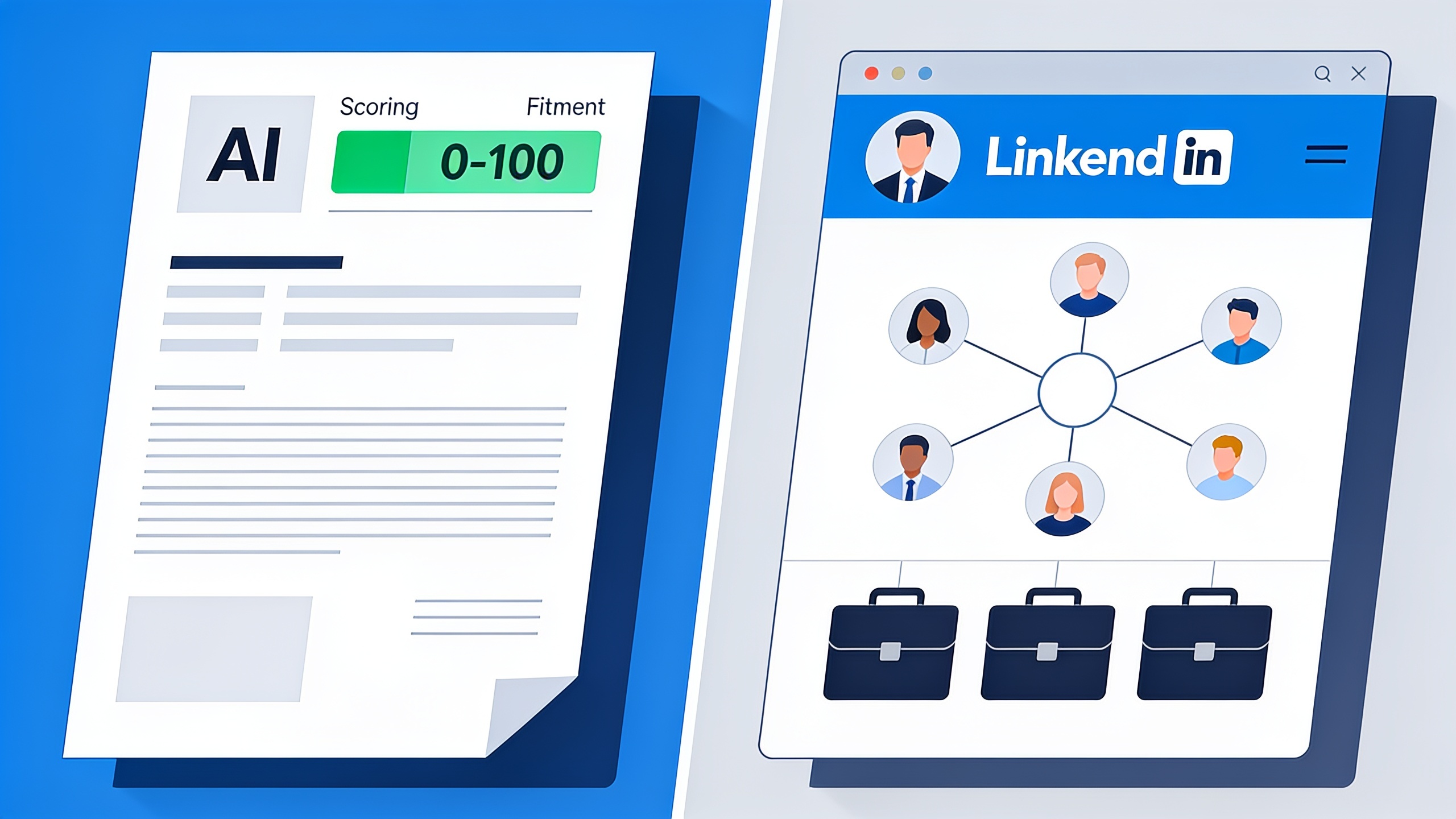
So let's sort out where each one earns its keep, and how grads, career switchers, and people firing off applications by the dozen can run both without doubling their workload.
Table of Contents
- What Is JobScans and How Does Its Fitment Score Work?
- What Is LinkedIn and Why Do Job Seekers Use It?
- JobScans vs LinkedIn: Core Differences in Approach
- Resume Scoring Tool vs Networking: Which Matters More for Getting Hired?
- When Should You Use JobScans vs LinkedIn?
- Can You Use JobScans and LinkedIn Together?
- How Much Does JobScans Cost Compared to LinkedIn?
- Frequently Asked Questions
What Is JobScans and How Does Its Fitment Score Work?
JobScans is an AI job-search platform built for job seekers in India that looks at how well your résumé matches a specific job posting and hands you back a fitment score from 0 to 100. So instead of squinting at a listing and wondering whether you're "qualified enough" to bother applying, you drop in your CV against that job description and get an actual number telling you how you stack up for that one role.
And that's the part people miss. It's job-specific. The exact same résumé can score wildly differently against two different postings, depending on how closely your skills, experience, and keywords line up with what each employer is fishing for. This is nothing like a generic résumé review or a quick LinkedIn profile once-over.
But it doesn't just leave you with a number and a shrug. According to JobScans' own platform description, the tool auto-tailors your résumé to the job you're targeting and can spit out a matching cover letter too. So you go from "here's your score" to "here's a fixed document" in one sitting.
If you're the kind of person applying to a couple dozen postings a week, this is the whole point. Rewriting a résumé by hand for every single application is exhausting, and honestly, most people do it badly when they're tired. A resume scoring tool like this gives you a concrete, repeatable way to sanity-check alignment before you hit submit, instead of relying on a vague feeling that your experience section "reads fine." It's free to start, too, which makes it a pretty low-stakes thing to test before you decide whether to lean on it during a heavy search.
If you want to see how this fitment model stacks up against the more traditional India-focused job boards, JobScans vs Naukri: Which Helps You Land Jobs Faster? digs into scoring versus straight-up listings.
What Is LinkedIn and Why Do Job Seekers Use It?
LinkedIn is a professional networking platform where you build a public profile, connect with colleagues and recruiters, follow companies, and browse jobs posted right there on the site. The whole thing is built on the idea that your career grows through visible relationships. Recommendations, endorsements, shared connections, recruiters sliding into your inbox. Not just through polishing a document until it shines.
The scale is genuinely massive. LinkedIn has said publicly it has more than 1 billion members across over 200 countries and territories, according to LinkedIn's own newsroom figures. That's one of the largest professional networks on the planet. For job seekers, all that scale boils down to three real uses: keeping a searchable profile so recruiters can find you, applying to jobs posted by companies and recruiters, and building relationships (old coworkers, alumni, people in your industry) that can turn into referrals or a quiet introduction.
Here's where LinkedIn is totally different from a scoring tool, though. It will never tell you, numerically, how well your profile or résumé matches a specific job. It surfaces opportunities and people, and then it's on you to judge fit, tailor your pitch, and follow up. If you're good at working relationships and want to be seen beyond a single application, that's a strength. But if what you actually want is a clean, instant answer to "does my résumé match this job or not?", it can feel frustratingly fuzzy.
JobScans vs LinkedIn: Core Differences in Approach
The core difference comes down to this: JobScans measures fit between a document and a job, while LinkedIn builds visibility and relationships around a person. Neither is "better" in some abstract sense. They're just aimed at different parts of the hunt.
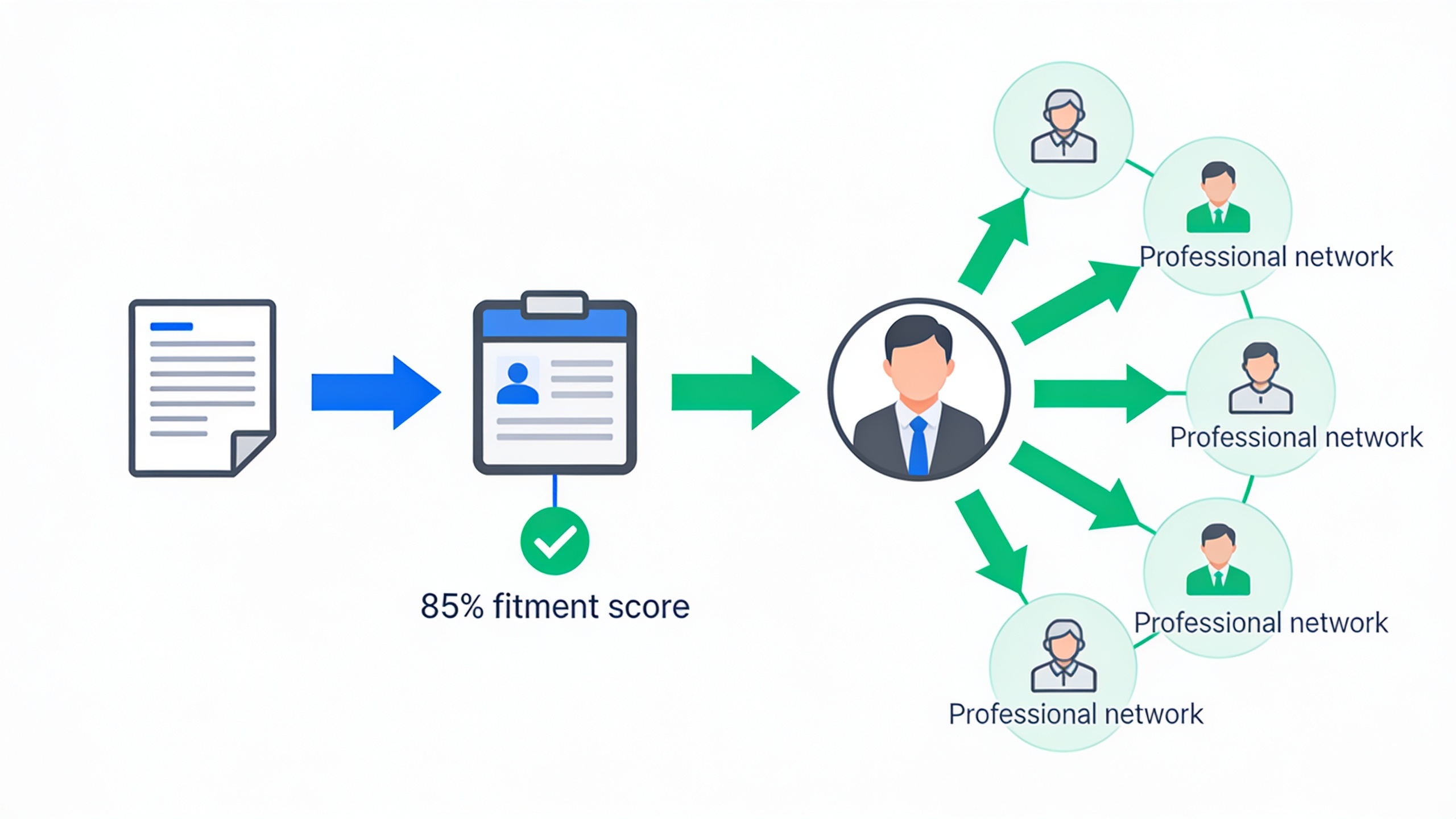
Fitment Scoring: Document-First, Job-Specific
JobScans starts with a job description and a résumé and gives you a fitment score for that exact pairing. You get a number, and based on the platform's stated features, a tailored version of your résumé plus a cover letter aligned to that role. It's a closed loop. Transactional, in a good way. You get a measurable result you can act on right now, and you can run it again for every job you're eyeing.
Networking: Relationship-First, Visibility Over Time
LinkedIn works the opposite way. Your profile sits there, visible to a network that (ideally) keeps growing: connections, followers, recruiters, companies. There's no fitment score against a posting. Instead it leans on search, recommendations, and human judgment (yours and the recruiter's) to figure out whether you're a fit. The payoff is slower and less immediate than a scoring tool. But it can crack open doors a document never could, like a warm intro from someone you both know.
Where the Two Naturally Overlap
Both tools eventually funnel into the same moment: you clicking apply. LinkedIn is often where you find the posting or the recruiter. JobScans is where you check and sharpen the résumé you're about to send. Neither one gets you off the hook for actually tailoring your materials, and if you've never really done that, How to Tailor Your Resume for Every Job Application walks through the nuts and bolts of adjusting a résumé per role instead of blasting the same version everywhere.
Resume Scoring Tool vs Networking: Which Matters More for Getting Hired?
Neither one wins outright. It depends on what stage you're at and how you personally tend to get noticed. If you're applying to postings where an employer screens résumés against a job description (which is basically all high-volume hiring), fitment scoring is directly relevant. If you're chasing roles that never get publicly posted, or ones that live and die on referrals, networking carries way more weight.
Here's a side-by-side on how the two compare across the stuff people usually care about:
| Dimension | JobScans (Fitment Scoring) | LinkedIn (Networking) |
|---|---|---|
| Core mechanism | AI-generated 0–100 fitment score comparing your CV to a specific job | Public profile, connections, and job listings; no stated fitment scoring |
| Primary output | A score plus an auto-tailored résumé and generated cover letter | Visibility to your network, recruiters, and companies you follow |
| Speed of feedback | Immediate — score and tailored document generated per job | Gradual — depends on profile views, connection growth, recruiter interest |
| Best for | Quickly checking and improving fit for specific job postings | Building long-term visibility, referrals, and recruiter contact |
| Focus | Document (résumé/cover letter) | Person (profile and relationships) |
| Region focus | Built for job seekers in India | Global platform, over 1 billion members (LinkedIn Newsroom) |
| Starting cost | Free to start | Not covered in this comparison; not part of JobScans' source material |
| Networking features | Not stated publicly | Core feature — connections, follows, messaging |
| Résumé tailoring | Core feature — auto-tailors résumé per job | Not stated publicly |
The split is pretty stark once you lay it out. JobScans is optimized for the exact moment you're deciding whether and how to apply. LinkedIn is optimized for the months and years you spend building a professional presence. If you've only got time for one thing before a deadline hits, checking your fitment score and fixing your résumé is the faster, more immediate lever. But that doesn't erase the slow-burn value of a solid LinkedIn presence.
When Should You Use JobScans vs LinkedIn?
Use JobScans when you've got a specific posting in front of you and need to know how well your résumé matches it right now. Use LinkedIn when you want to be findable, build relationships, or dig up those postings and recruiters in the first place. Different questions, so your "right" answer shifts depending on where you are in the process.
For Recent Graduates
If you're fresh out of school with barely any work history, your résumé probably doesn't naturally carry the keywords and phrasing that screening tools sniff for. Running your CV through a fitment score before you apply can flag the gaps (missing skills, muddy phrasing, formatting weirdness) so you can patch them up first. And at the same time, a LinkedIn profile listing your degree, projects, and internships helps campus recruiters and alumni actually find you and maybe refer you in. A scoring tool can't do that part for you.
For Career Changers
Switching industries comes with a very particular headache: your résumé is written in the language of your old field, not your new one. A fitment score against a posting in your target industry shows you, in cold numbers, how far off you are and where JobScans' auto-tailoring can reframe things. Honestly, though, networking probably matters more for this group than any other. A referral or intro from someone already inside the new industry can absolutely outweigh a résumé that scores fine on paper but comes from an unfamiliar background.
For Active, High-Volume Job Seekers
If you're firing off applications to a pile of roles in a short window, tailoring each one by hand just isn't sustainable. This is where a resume scoring tool earns its spot in your routine, because checking fitment and generating a tailored version per job beats rewriting from scratch every single time. LinkedIn still matters here, mostly as a lead source. Postings, recruiter messages, company follows, all of which feed into what you then run through JobScans before you apply.
Can You Use JobScans and LinkedIn Together?
Yes, and honestly this is the smart move. One platform gives you a discoverable presence and a way to find roles. The other checks and improves the actual document you submit. There's zero conflict because they're not fighting over the same job.
A routine that works: use LinkedIn to build your profile, follow the companies you want, and find postings or recruiter contacts. Then, before you apply to anything specific, run your résumé through JobScans for a fitment score and an auto-tailored version aligned to that job's description. And if it generates a cover letter for that role too, like the site describes, you can pair that with your LinkedIn-sourced application and send a more complete, targeted package.
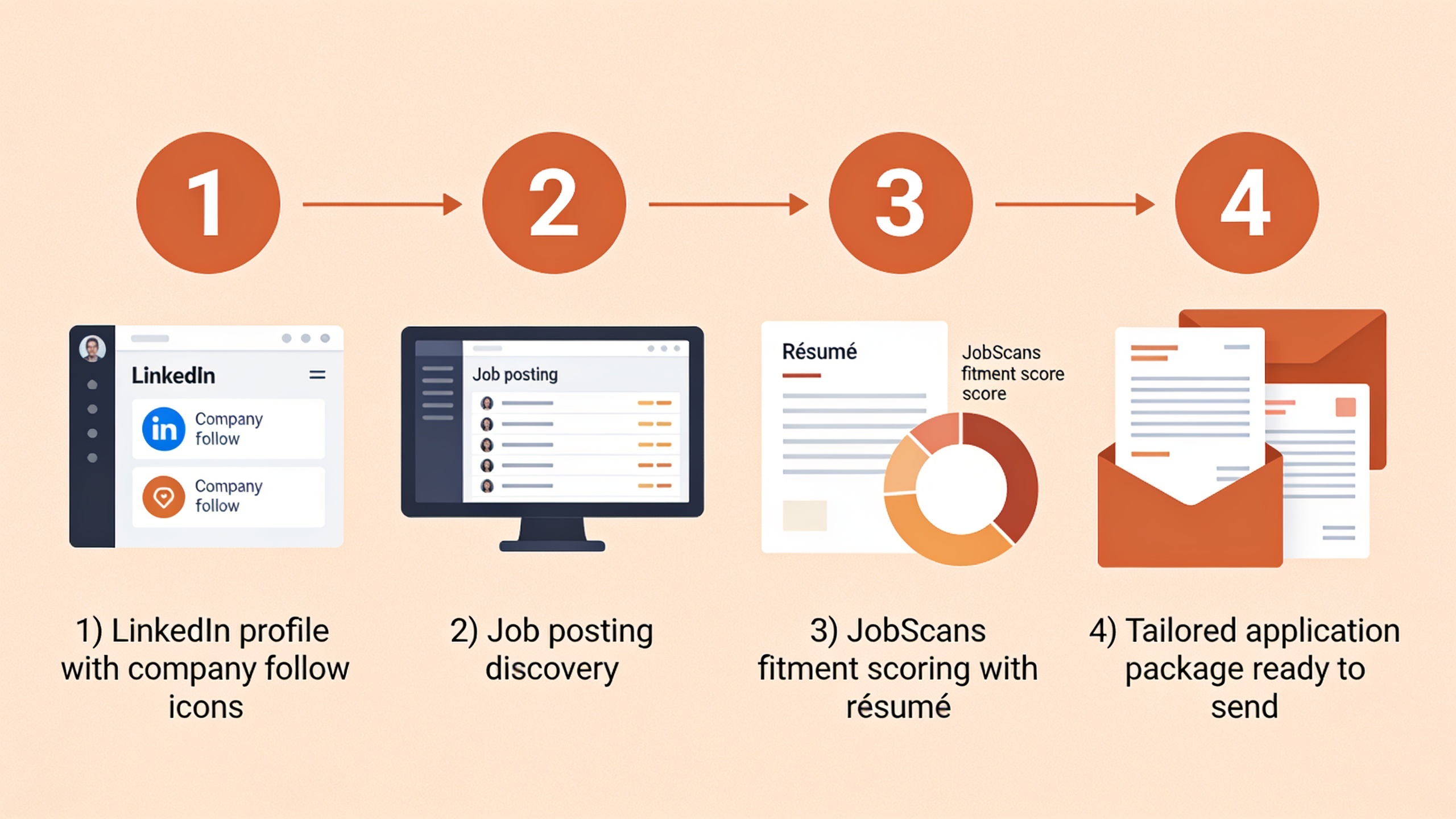
The trap to avoid is treating either one as the whole solution. A flawless résumé does nothing if nobody sees it because your LinkedIn is a ghost town. Flip it around: a huge network and a stack of profile views won't turn into interviews if the résumé you actually send isn't tuned to what the employer is screening for. Combine the two and you're covering both sides.
How Much Does JobScans Cost Compared to LinkedIn?
JobScans is free to start, according to its own platform description, so you can pull an initial fitment score and poke at the résumé and cover letter features without paying anything upfront. Past that, specific pricing tiers or paid plan details aren't stated publicly in JobScans' available material, so check the platform directly for current plan specifics before you assume what's bundled at each level.
As for LinkedIn, its pricing (premium tiers, recruiter tools, paid job-seeker features, all of it) isn't covered in the source material used for this comparison, so I'm not going to make up numbers here. Generally speaking, based on how people actually use it, LinkedIn's core stuff (building a profile, connecting, browsing publicly posted jobs) works without a paid account, while the extra visibility and messaging features usually sit behind subscription tiers, as they tend to on most networking platforms. If cost is a dealbreaker for you, just verify the current details on LinkedIn's own site rather than trusting assumptions.
The practical read on money: JobScans' free starting point makes it basically risk-free to test whether fitment scoring changes how your applications land. Pair that with a LinkedIn profile, which costs nothing at the basic level, and you can build both halves of your search without dropping any real cash upfront.
Frequently Asked Questions
Is JobScans a replacement for LinkedIn?
No. JobScans is about scoring and tailoring your résumé against specific job descriptions, while LinkedIn is about networking, visibility, and finding jobs. Different purposes. They're meant to complement each other, not replace one another.
Does LinkedIn give a fitment score like JobScans does?
Based on publicly available info about LinkedIn's core platform, no, it doesn't hand you a numeric fitment score comparing your résumé to a specific posting the way JobScans does. LinkedIn's strengths are networking, profile visibility, and job listings, not document-level scoring.
Can I use my LinkedIn profile info to build a résumé for JobScans?
JobScans works by analyzing a CV you upload against a job description to generate a fitment score, auto-tailor the résumé, and produce a cover letter. Whether it pulls directly from a LinkedIn profile isn't stated publicly, so the safe bet is to have an updated résumé file ready to upload.
Which is better for a recent grad with no work experience: JobScans or LinkedIn?
Both help, just differently. A LinkedIn profile gets recent grads discovered by recruiters and connected with alumni for referrals, while JobScans pinpoints and fixes résumé gaps against specific postings. Using both together covers a lot more ground than picking one.
How is JobScans different from a general resume scoring tool that ignores the specific job description?
According to JobScans' platform description, its scoring is tied to a specific posting each time, producing a 0–100 fitment score for that pairing instead of a generic résumé quality rating. The point is to reflect how closely your résumé matches what one particular employer is actually asking for, rather than a one-size-fits-all grade.
So, JobScans versus LinkedIn isn't really an either/or thing. It's about knowing what each one is built for. If you need a clear, instant read on whether your résumé fits a job you're about to apply to, a resume scoring tool like JobScans gives you that plus a tailored document to send. If you need visibility, connections, and a steady drip of opportunities over time, LinkedIn does the heavy lifting there. Most job seekers in India will get the most out of treating them as two halves of the same process: build your presence on LinkedIn, then fine-tune every single application with a fitment check before you hit submit.